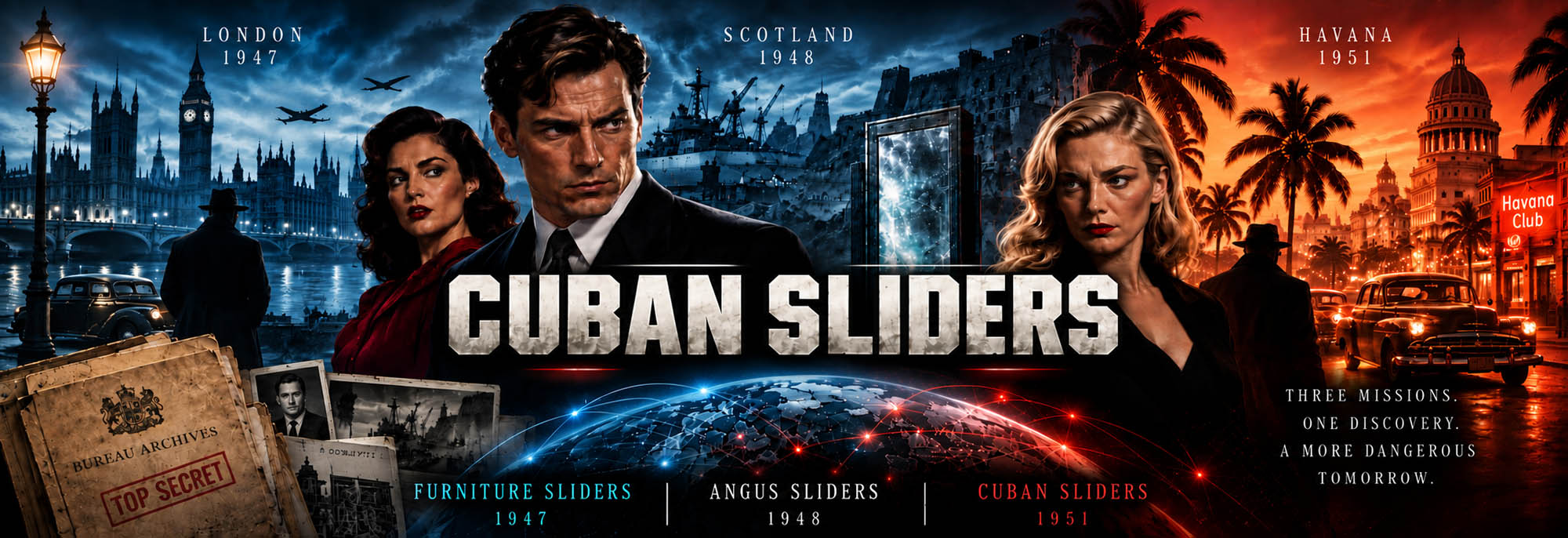




Cuba, 1951. The Cold War is intensifying, and the Caribbean is becoming a new battleground for intelligence agencies determined to control the scientific discoveries that emerged from the Second World War. Former British intelligence officer Max Calder is drawn into another dangerous investigation when the mysterious death of a Soviet scientist suggests that experimental technology known as the Mirror has resurfaced.
A physicist who appears to have aged impossibly quickly, a trail of clandestine scientific research and evidence of a secret installation in Cuba lead Max and Bureau operative Alicia Rayes into a conspiracy extending across international intelligence networks.
As British, American and Soviet interests converge on Havana, Max discovers that the struggle for the Mirror has entered a more dangerous phase. The technology's ability to disturb time, identity and physical reality is no longer its only threat. Research derived from the Mirror suggests possibilities for influencing human judgment itself.
Working in an environment of compromised loyalties, hidden laboratories and competing political ambitions, Max and Alicia must establish who controls the research, what its operators intend and whether the consequences can still be contained.
Blending historical espionage, atmospheric Caribbean locations and speculative science, Cuban Sliders brings the central mysteries of The Bureau Archives Trilogy into their most dangerous international setting.
The third novel in The Bureau Archives Trilogy — completing the original three-book story while establishing the foundations of Alexander Bentley's interconnected seven-book Cold War universe.
Cuban Sliders is available through major booksellers. Choose your preferred retailer to check available editions, formats and current pricing.
Buy Cuban Sliders on Amazon and explore available paperback and hardback print and Kindle editions.
Buy Cuban Sliders at Barnes & Noble and find available paperback and hardback print editions.
Buy Cuban Sliders at Waterstones. For readers in the United Kingdom and international customers, check Waterstones for available editions and delivery options.
Read Cuban Sliders on Apple Books and discover the digital edition for reading on compatible Apple devices.
Formats, prices, delivery options and regional availability are determined by each retailer.
Set in 1951, Cuban Sliders captures a world in which the wartime alliance between East and West has collapsed into open strategic rivalry. Soviet intelligence, British security services and the expanding American intelligence establishment are competing for influence, scientific knowledge and technologies capable of altering the international balance of power.
From Havana's waterfront and clandestine laboratories to the wider Caribbean intelligence network, the novel explores an environment where political ambitions, secret operations and scientific experimentation have become inseparable.
Max Calder has spent years attempting to understand the gaps in his memory and the extraordinary events surrounding the Mirror. His investigations have challenged his assumptions about his identity, his former intelligence colleagues and the organizations claiming to act in his interests.
In Cuba, those unresolved questions acquire new urgency. As the intelligence struggle intensifies, Max must rely on his instincts and his partnership with Alicia Rayes while confronting evidence that the technology he has pursued may possess capabilities far beyond those previously understood.
His investigation is both a professional assignment and a deeply personal confrontation with the secrets that have shaped his life.
At the heart of the novel lies the Mirror, an experimental technology whose effects challenge conventional understandings of time, identity and physical reality.
Its apparent reconstruction in Cuba raises the stakes of the scientific mystery established in the earlier novels. More disturbing still is the emergence of research suggesting that human judgment and decision-making may themselves become vulnerable to technological manipulation.
The speculative science remains embedded in the intelligence operations, political calculations and competing scientific ambitions of the early Cold War, creating a thriller in which experimental technology becomes a potential instrument of geopolitical power.
Cuban Sliders is the third novel in The Bureau Archives Trilogy, bringing together the central investigation introduced in Furniture Sliders and developed in Angus Sliders.
It also establishes the scientific and historical foundations for The Consensus Files, Alexander Bentley's subsequent four-book Cold War espionage series, in which a new generation of intelligence officers confronts the implications of technologies derived from the Mirror.
Although Cuban Sliders presents its own espionage investigation, readers wishing to follow the complete seven-book story are encouraged to begin with Furniture Sliders and continue through the trilogy in order.
Cuban Sliders has received a five-star review from Literary Titan, recognizing its combination of historical espionage, speculative science and international intrigue.
The novel brings the developing mysteries of The Bureau Archives Trilogy into the politically charged environment of the Caribbean, combining atmospheric settings, complex intelligence operations and the increasingly dangerous implications of the Mirror.
Readers and reviewers have praised the novel's atmospheric settings, intricate plotting, memorable characters and unusual combination of espionage and speculative science.
Want to know more about Cuban Sliders?
Explore the official book resources:
Read The Synopsis — Discover the premise and international espionage story without major spoilers.
Watch The Trailer — Experience the atmosphere of the novel through its cinematic trailer.
Meet The Characters — Learn more about Max Calder, Artemis and the people whose loyalties shape the investigation.
Read The Reviews — Explore professional criticism and reader reactions.
Cuban Sliders is Book Three of a three-part espionage story spanning the early Cold War.
Book One — Furniture Sliders (1947)
The investigation begins with a missing scientist, fractured memories and the discovery of the Mirror.
Book Two — Angus Sliders (1948)
The conspiracy deepens as the search for the Mirror leads into Scotland and the competing interests of British and Soviet intelligence.
Book Three — Cuban Sliders (1951)
The struggle moves to Cuba, where the consequences of the Mirror threaten to extend beyond the technology itself.
The story continues in The Consensus Files, beginning with The Teller Threshold (1955), introducing a new generation of intelligence officers and an even more dangerous scientific legacy.
Is Cuban Sliders the third book in the series?
Yes. Cuban Sliders is Book Three of The Bureau Archives Trilogy, continuing the story introduced in Furniture Sliders and developed in Angus Sliders.
Can Cuban Sliders be read on its own?
Yes. The novel presents its own espionage investigation and central mystery. However, several characters, organizations and scientific concepts are introduced in the earlier books, so reading the trilogy in order provides a fuller understanding of Max Calder's story.
Do I need to understand quantum physics to enjoy the novel?
No. The speculative scientific ideas are introduced through the characters and their investigations. The story remains focused on espionage, personal loyalties, suspense and the consequences of experimental technology.
Is Cuban Sliders historical fiction or science fiction?
It combines both. The early Cold War, international intelligence competition and political environment of 1951 provide the historical foundation, while the Mirror introduces the speculative scientific element.
Where should I begin if I want to read all seven novels?
Begin with Furniture Sliders, continue with Angus Sliders and Cuban Sliders, and then move to The Consensus Files, starting with The Teller Threshold.

Built by Alexander Bentley. Copyright © 2026 Alexander Bentley