
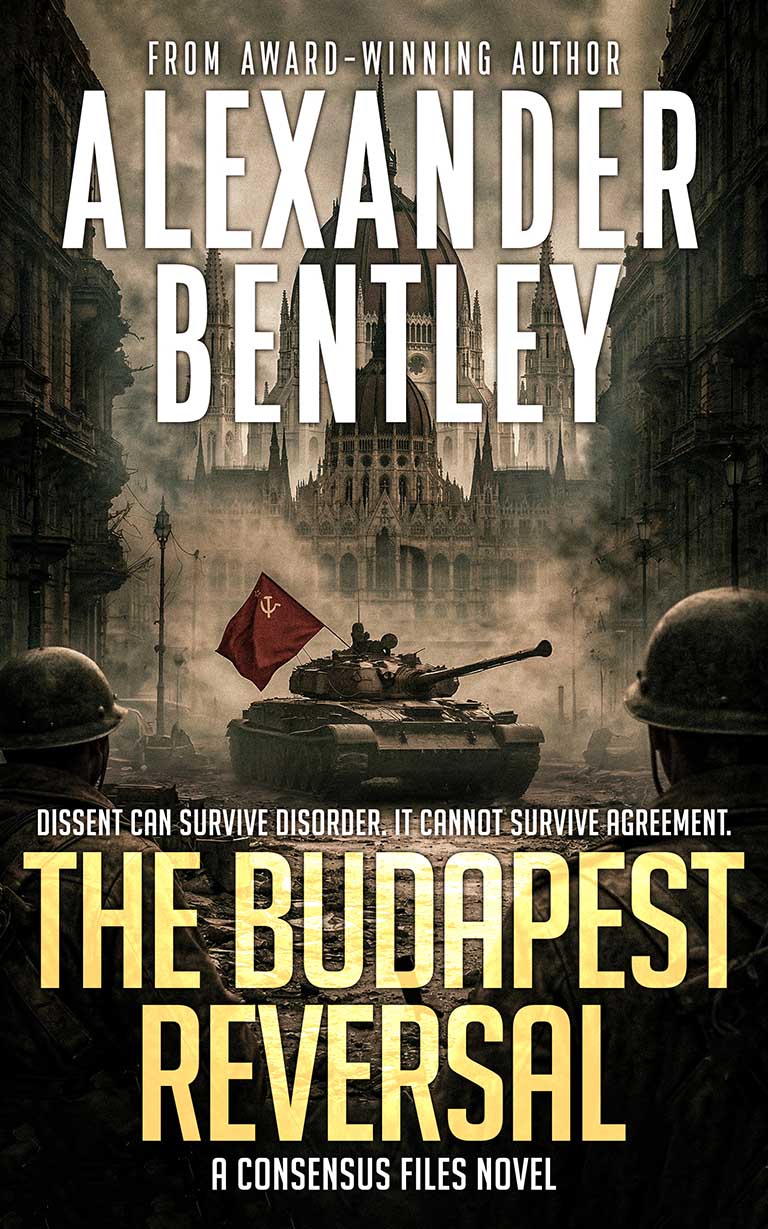
Hungary, 1956. As thousands take to the streets of Budapest demanding political freedom, the Soviet Union faces a crisis that threatens its authority across Eastern Europe. In Washington, London and Paris, Western governments struggle to agree on a response. But beneath the familiar tensions of the Cold War, another conflict is developing—one in which the decisions of governments may prove more dangerous than the weapons they command.
For British intelligence officers Giles Harrington and Lucy Howard, the events unfolding in Hungary raise disturbing questions. Following their investigation into Decision Locking, a technology capable of narrowing human judgment until disagreement disappears, they know that political consensus is not always what it appears to be. When intelligence reports suggest renewed interest in the technology, they are drawn into an investigation spanning European capitals, NATO installations and the increasingly volatile intelligence networks of the Eastern Bloc.
In Moscow, KGB Major Viktor Kolyadin recognizes that political instability presents both a threat and an opportunity. Methodical and strategically ambitious, he understands that the ability to influence decisions without conventional coercion could fundamentally alter the balance of power. As divisions emerge within the Soviet leadership, the distinction between genuine political agreement and manufactured certainty becomes increasingly difficult to establish.
Meanwhile, NATO faces its own crisis. The Hungarian uprising has exposed the limitations of Western influence, while disagreements over nuclear strategy threaten the alliance's cohesion. Proposals to accelerate the deployment of tactical nuclear weapons intensify debates among governments already struggling to reconcile national interests with collective security. Within this atmosphere of uncertainty, even apparently routine intelligence and military decisions acquire potentially catastrophic significance.
Working with the Office of Decision Integrity, Giles and Lucy pursue separate but interconnected investigations into suspicious intelligence activity and vulnerabilities within Western defense systems. Their assignments carry them beyond diplomatic meetings and intelligence briefings into dangerous field operations, where compromised communications, uncertain loyalties and carefully concealed agendas threaten both their missions and their lives.
CIA officer Daniel Mercer and MI6 political analyst Eleanor Whitcombe become increasingly important figures in a struggle that crosses institutional and national boundaries. Yet cooperation between allied intelligence organizations is never straightforward. Information is withheld, competing priorities interfere with investigations, and decisions that appear individually reasonable may produce consequences nobody intended.
Complicating matters further is Grant Baldwin, the controversial American intelligence officer whose involvement with Decision Locking has already challenged the loyalties and judgment of those attempting to control it. His ambitions and uncertain position within the intelligence establishment remain a source of concern, particularly as evidence emerges that the technology's potential has attracted attention far beyond its original developers.
As Soviet forces confront resistance in Hungary and NATO debates the future of European security, Giles and Lucy find themselves investigating a disturbing possibility: that the most consequential decisions of the Cold War might be influenced without anyone recognizing that their freedom to choose has been compromised. In an intelligence world built upon secrecy, deception and competing interpretations of events, determining what is genuine becomes as important as discovering who is responsible.
The Budapest Reversal, the second novel in The Consensus Files, combines the historical drama of the 1956 Hungarian uprising with Cold War espionage, covert field operations and speculative quantum science. Against a backdrop of Soviet political intrigue, NATO nuclear strategy and the struggle for Hungarian independence, Alexander Bentley explores the fragile boundary between persuasion and manipulation, and the danger of allowing certainty to replace independent judgment.
When governments reach decisions that could change history, how can anyone be certain those decisions were truly their own?

Built by Alexander Bentley. Copyright © 2026 Alexander Bentley