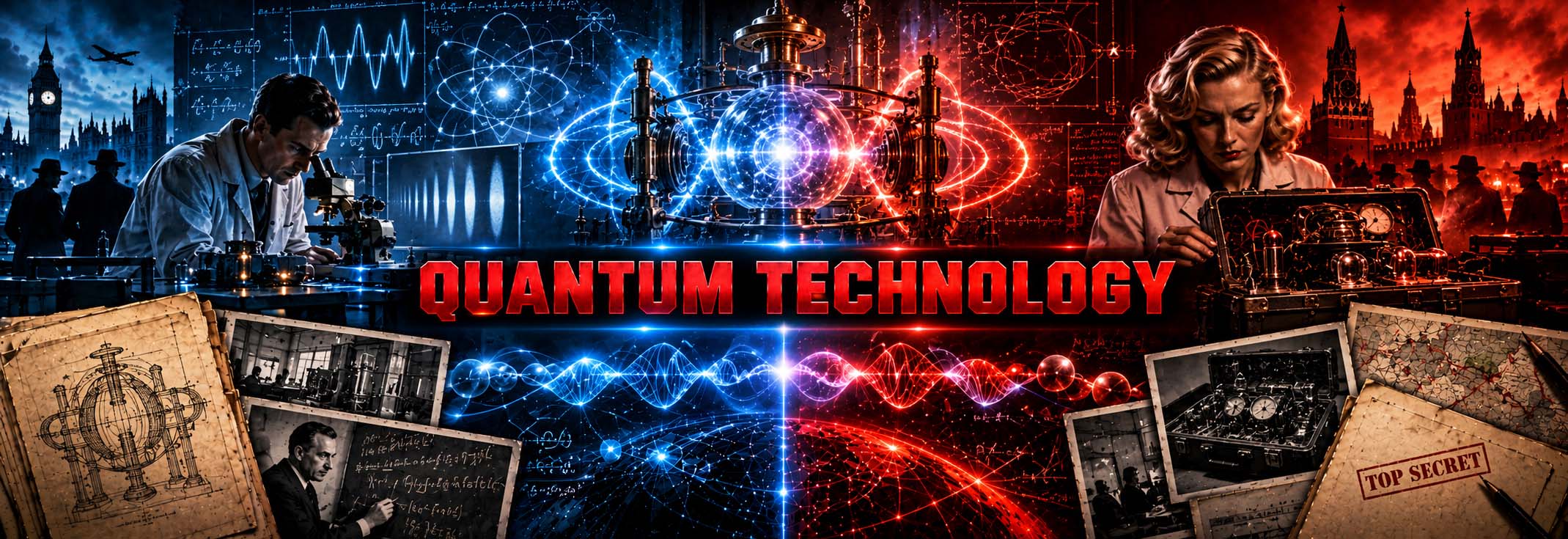
The Cold War was fought not only by intelligence officers, soldiers and politicians, but also by scientists. Behind the development of nuclear weapons, radar, communications systems and increasingly sophisticated surveillance technologies lay a scientific revolution that had begun decades earlier: quantum mechanics.
By the middle of the twentieth century, physicists had discovered that the universe behaved in ways that challenged conventional understanding. Particles could exhibit wave-like properties. Measurements were governed by probabilities rather than absolute certainty. Under carefully controlled conditions, quantum systems could become correlated in ways that classical physics could not adequately explain.
These discoveries were real. Their implications were profound. And they provided the scientific inspiration for Alexander Bentley's two interconnected Cold War espionage series, The Bureau Archives Trilogy and The Consensus Files.
At the centre of the fictional universe are two technologies: the Mirror, which challenges the boundaries of physical reality, and Decision Locking, which threatens something equally fundamental—the freedom to choose.
Neither technology exists in the form described in the novels. Both are speculative extensions of scientific ideas, developed within a fictional Cold War history in which intelligence agencies attempt to exploit discoveries they only partially understand.
The science provides the foundation. The fiction explores the consequences.
Classical physics, developed through the work of Isaac Newton and others, describes a world in which physical events follow predictable laws. Given sufficient information about an object's position, velocity and the forces acting upon it, its future behaviour can, in principle, be calculated.
Quantum mechanics introduced a radically different description of nature.
At atomic and subatomic scales, physical systems are represented by mathematical states that determine the probabilities of possible measurement outcomes. A particle may behave as a wave in one experiment and as a localized object in another. Certain physical properties cannot simultaneously be specified with unlimited precision.
The Heisenberg uncertainty principle expresses one of these limitations:
Δx × Δp ≥ ℏ/2
In simplified terms, the more precisely a particle's position is specified, the less precisely its momentum can be specified at the same time.
This is not a limitation caused merely by imperfect measuring instruments. It is a fundamental property of quantum theory.
By the 1950s, quantum mechanics was already central to modern physics. It helped explain atomic structure, chemical bonding, nuclear processes and the behaviour of materials. It also underpinned technologies that would eventually transform electronics and computing.
For the fictional scientists of The Bureau Archives, however, the most intriguing possibility lies in a question that quantum mechanics does not answer in the way the novels imagine:
What if the alternatives described by quantum theory could somehow become accessible at the scale of human experience?
That question leads to the Mirror.
The Mirror is the central scientific mystery of The Bureau Archives Trilogy.
Developed through secret wartime research, it is an experimental apparatus whose behaviour suggests that the boundaries between physical states, identities and possible histories may not be as stable as conventional experience implies.
Its fictional scientific foundations draw inspiration from quantum superposition, entanglement, decoherence and interpretations of quantum mechanics involving multiple possible histories.
Quantum superposition describes how a quantum system can be represented by a combination of states until a measurement produces a particular outcome.
Quantum entanglement occurs when systems share correlations that cannot be explained by assigning each system an independent classical state.
Decoherence describes how interactions with the surrounding environment suppress observable interference between components of a quantum state, helping explain why the everyday world appears classical.
These are established scientific concepts. But the Mirror extends them far beyond anything demonstrated experimentally.
In the novels, the apparatus appears capable of producing effects involving time, physical identity and the relationship between alternative states of reality. Its fictional engineering assumes that phenomena normally associated with microscopic quantum systems can be manipulated at a macroscopic scale.
Contemporary physics provides no established mechanism for doing this.
The Mirror is therefore not a prediction of a future invention. It is a speculative device built around a scientific question: if the physical world contains possibilities that ordinary human experience cannot reveal, what might happen if those possibilities could be manipulated?
For the intelligence officers pursuing it, the answer is not simply a matter of scientific discovery. A technology capable of challenging conventional reality would also challenge national security, political authority and the reliability of intelligence itself.
One of the greatest difficulties in applying quantum behaviour to large objects is the interaction between a system and its environment.
Quantum experiments often require extraordinary isolation and precision. Even small disturbances can destroy the delicate interference effects that scientists are attempting to observe.
Decoherence helps explain why macroscopic objects do not ordinarily display the same readily observable quantum interference as carefully controlled microscopic systems.
A laboratory can demonstrate quantum interference using photons, electrons, atoms and, under specialized conditions, increasingly complex physical systems. That does not mean a person can be transported between alternative histories or that memories can be exchanged between parallel realities.
In The Bureau Archives, the fictional scientists confront precisely this obstacle. The Mirror's experimental architecture assumes the possibility of maintaining and manipulating quantum relationships on a scale far beyond established technology.
Its unpredictable behaviour reflects a recurring theme of the trilogy: the difference between understanding a scientific principle and possessing the ability to control its consequences.
The more ambitious the experiment, the greater the danger of confusing theoretical possibility with practical mastery.
The scientific premise of The Consensus Files emerges from the fictional legacy of the Mirror.
Rather than attempting to manipulate time or physical identity, Decision Locking applies speculative principles to human judgment.
Its objective is deceptively simple: to reduce the alternatives a person is capable of considering until a particular decision appears natural, reasonable and inevitable.
The person affected does not necessarily experience an external command. There may be no visible coercion, no threat and no conscious awareness that anything has changed.
The individual believes the decision is their own.
In the fictional world of The Consensus Files, Decision Locking is described as the compression of viable alternatives—consensus without persuasion.
This is not an established application of quantum mechanics. No demonstrated quantum technology can selectively eliminate human political choices, control complex decisions or manufacture agreement in the manner depicted in the novels.
However, the concept draws upon genuine questions from cognitive science, psychology and decision theory.
Human judgment is not a perfectly rational process. Decisions are influenced by how information is presented, which alternatives are made available, the expectations of others and the mental shortcuts people use when confronting uncertainty.
The fictional leap made by Decision Locking is to transform these ordinary vulnerabilities into a technological mechanism capable of manipulating the decision process itself.
The resulting danger is not merely that people might be persuaded to make the wrong choice.
It is that they might never recognize the existence of another choice.
Psychologists and behavioural scientists have long studied the relationship between individual judgment, social influence and collective decision-making.
Research into conformity, obedience, groupthink and cognitive bias demonstrates that people do not make decisions in isolation from their social and institutional surroundings.
Groups may suppress disagreement in pursuit of harmony. Individuals may defer to perceived authority. Organizations may favour established procedures even when circumstances demand new thinking.
None of these phenomena requires fictional technology.
They are ordinary features of human behaviour.
The danger becomes particularly significant when decisions are made within powerful institutions—governments, intelligence agencies, military commands and scientific organizations.
An intelligence assessment can become influential because it supports an existing policy. A committee may reach agreement because its members assume that objections have already been considered. A government may mistake the absence of visible dissent for the presence of genuine consent.
In the real world, these effects arise from psychology, incentives, organizational culture and political pressure.
In The Consensus Files, Decision Locking introduces a speculative mechanism capable of intensifying such effects beyond ordinary human limitations.
The novels therefore explore two related but distinct questions.
Can technology influence what people decide?
And can institutions become so conditioned toward agreement that they begin to suppress alternatives without any external technological intervention?
The first question drives the early development of Decision Locking. The second becomes increasingly important as the series progresses.
Quantum entanglement is among the most frequently misunderstood concepts in modern physics.
When two systems are entangled, measurements performed on them can reveal correlations that cannot be reproduced by certain classical explanations.
These correlations can persist even when the systems are widely separated.
However, entanglement does not permit ordinary information to be transmitted instantaneously across arbitrary distances. The outcomes of individual measurements cannot be controlled in a way that allows faster-than-light messaging.
This distinction is essential.
In The Consensus Files, the fictional evolution of Decision Locking explores the possibility of coordinating effects between separated devices. The speculative technology borrows ideas from quantum correlations while introducing capabilities that have no demonstrated counterpart in real physics.
The novels do not claim that entanglement itself enables remote control of human behaviour.
Instead, they ask what might happen if an intelligence service developed an entirely new method of influencing decisions across geographical distances.
Such a capability would transform the strategic importance of communications, political institutions and international alliances.
A weapon would no longer need to destroy a target.
It might only need to influence the decisions made within it.
The fictional events of The Teller Threshold unfold against a real period of extraordinary scientific and political tension.
Edward Teller was a Hungarian-born American theoretical physicist who played an important role in the development of thermonuclear weapons. His work, and the broader American nuclear weapons programme, reflected the growing relationship between scientific research and national security.
During the early Cold War, laboratories such as the University of California Radiation Laboratory at Livermore became central to American nuclear research.
The scientific advances involved were real. The political arguments surrounding nuclear weapons, deterrence and national security were equally real.
In the novels, Teller encounters a fictional scientific development whose potential consequences extend beyond nuclear warfare.
His involvement provides an opportunity to examine a broader historical dilemma: when scientists develop technologies of extraordinary strategic importance, where does responsibility for their use ultimately reside?
With the scientist who understands the invention?
The military organization seeking to deploy it?
The intelligence service attempting to control it?
Or the government claiming authority over its consequences?
These questions were central to the nuclear age and remain relevant to emerging technologies today.
The Teller depicted in the novels participates in fictional events. His association with Decision Locking is an invention of the author, not a historical claim.
Conventional fictional mind-control devices typically force individuals to obey commands or behave against their conscious wishes.
Decision Locking operates on a different premise.
Its fictional mechanism does not simply issue instructions. It narrows the alternatives available to the mind, leaving a preferred conclusion apparently unchallenged.
The distinction matters because the resulting decision may feel entirely voluntary.
A politician may believe a compromise is the only reasonable outcome. A military commander may become convinced that one strategy is self-evidently correct. An intelligence officer may overlook an alternative that would ordinarily demand consideration.
The danger lies in the disappearance of doubt.
Doubt is frequently regarded as an obstacle to efficient decision-making. Yet it is also an essential part of independent judgment.
Disagreement can expose weak assumptions, identify overlooked risks and prevent organizations from becoming trapped by their own expectations.
In the fictional world of Decision Locking, the suppression of alternatives offers the appearance of perfect administrative efficiency.
Meetings become shorter. Arguments disappear. Consensus arrives effortlessly.
But efficiency is not necessarily evidence of freedom.
And unanimity is not necessarily evidence of truth.
The final novel in The Consensus Files examines a question that moves beyond the capabilities of any individual scientific apparatus.
What happens when the organizational habits created by repeated decision-making begin to resemble the effects of Decision Locking itself?
Governments depend upon procedures, hierarchies, conventions and shared assumptions. These mechanisms make complex institutions possible.
But they can also encourage conformity, discourage dissent and make established conclusions difficult to challenge.
In The House Protocol, the fictional investigation takes place against the political and security pressures confronting Britain in 1961.
The central scientific question becomes inseparable from an institutional one.
If an organization repeatedly narrows the range of acceptable alternatives, does it eventually require an external mechanism to continue doing so?
This is not a claim that real governments possess hidden quantum decision-control systems.
It is a speculative examination of how scientific ideas about constrained alternatives can illuminate the very real vulnerabilities of institutional judgment.
The technology is fictional.
The danger of unquestioned consensus is not.
The scientific ideas underlying Alexander Bentley's novels fall into three categories.
Established science: Quantum superposition, entanglement, uncertainty, decoherence, nuclear physics, and the psychological and organizational influences on human decision-making are genuine subjects of scientific research.
Speculative extrapolation: The possibility of maintaining and controlling complex quantum relationships at human scales, or applying novel physical mechanisms to cognitive processes, extends far beyond established experimental capabilities.
Fictional technology: The Mirror, its various experimental configurations, the portable Decision Locking Node, and the advanced systems developed throughout The Consensus Files are inventions created for the novels.
The distinction is deliberate.
The purpose of the fiction is not to suggest that these devices secretly existed during the Cold War. It is to place an imagined scientific breakthrough inside a historically recognizable intelligence environment and explore how governments, scientists and individuals might respond.
The Cold War provides a particularly compelling setting because scientific discovery and political power were already deeply intertwined.
Nuclear weapons demonstrated that theoretical physics could reshape international relations. Intelligence agencies competed to acquire scientific knowledge. Governments made decisions whose consequences could extend far beyond their national borders.
Against that background, the Mirror and Decision Locking introduce a different kind of strategic danger.
Nuclear weapons threaten destruction.
The Mirror threatens the stability of reality.
Decision Locking threatens the freedom to choose.
Science attempts to explain how the universe works. Politics concerns how human beings organize power and make collective decisions.
The Mirror and Decision Locking bring those two worlds into conflict.
Across The Bureau Archives Trilogy and The Consensus Files, the fictional technology changes, the intelligence officers change, and the Cold War moves through successive crises.
But one question remains constant.
Is a world without conflict worth the price of a world without choice?
Discover how the scientific mystery begins in The Bureau Archives Trilogy and evolves into the struggle over human judgment in The Consensus Files.

Built by Alexander Bentley. Copyright © 2026 Alexander Bentley