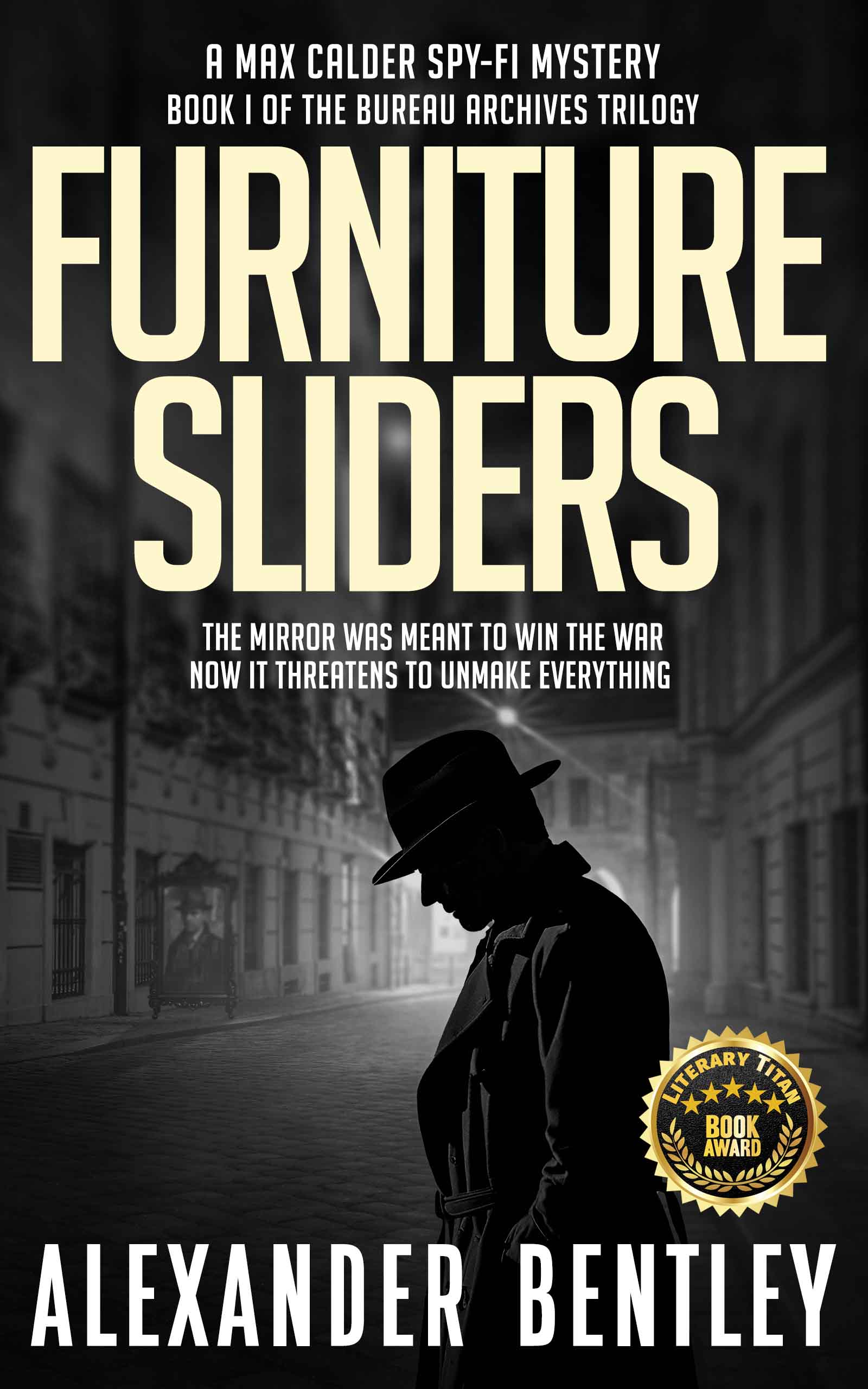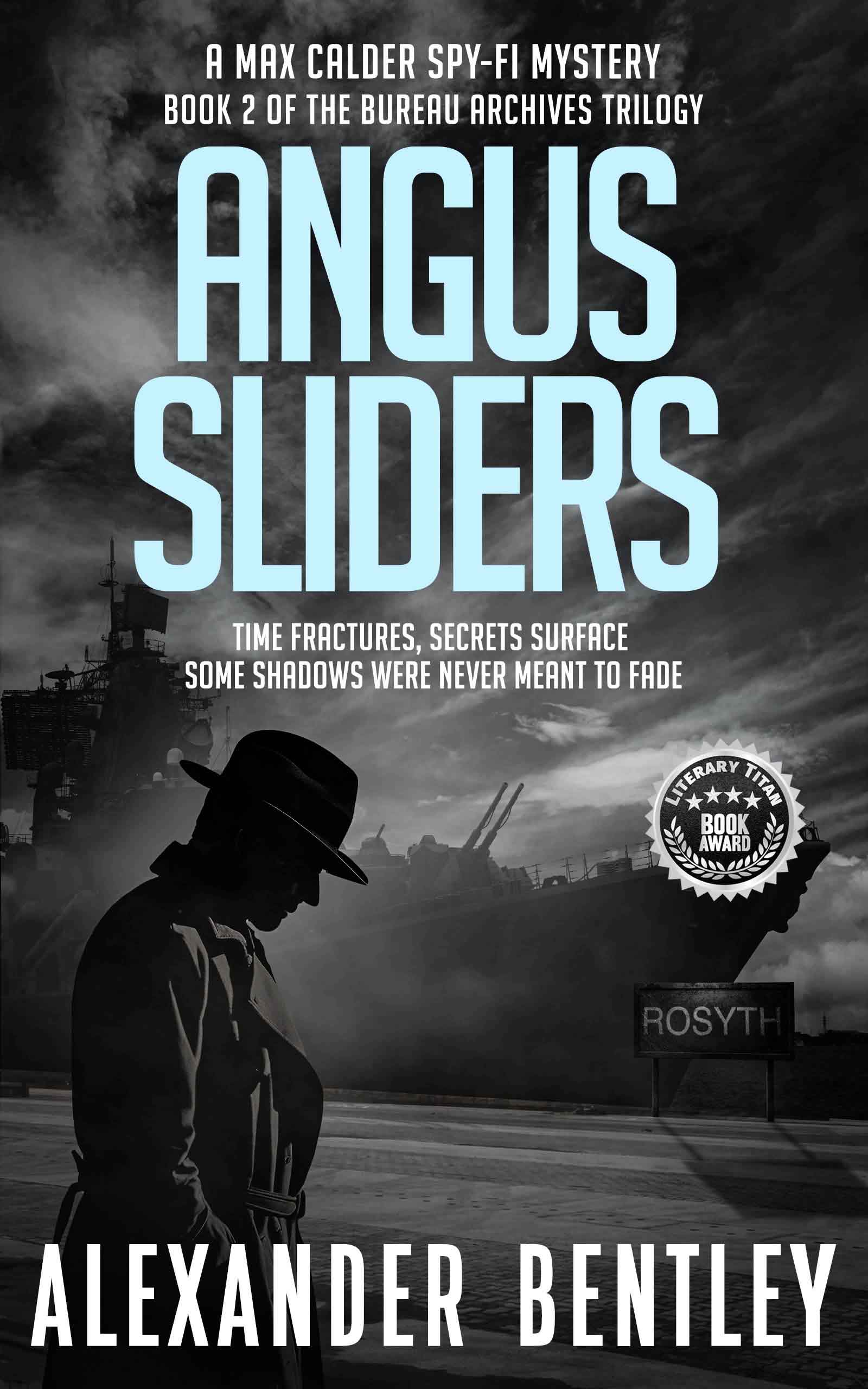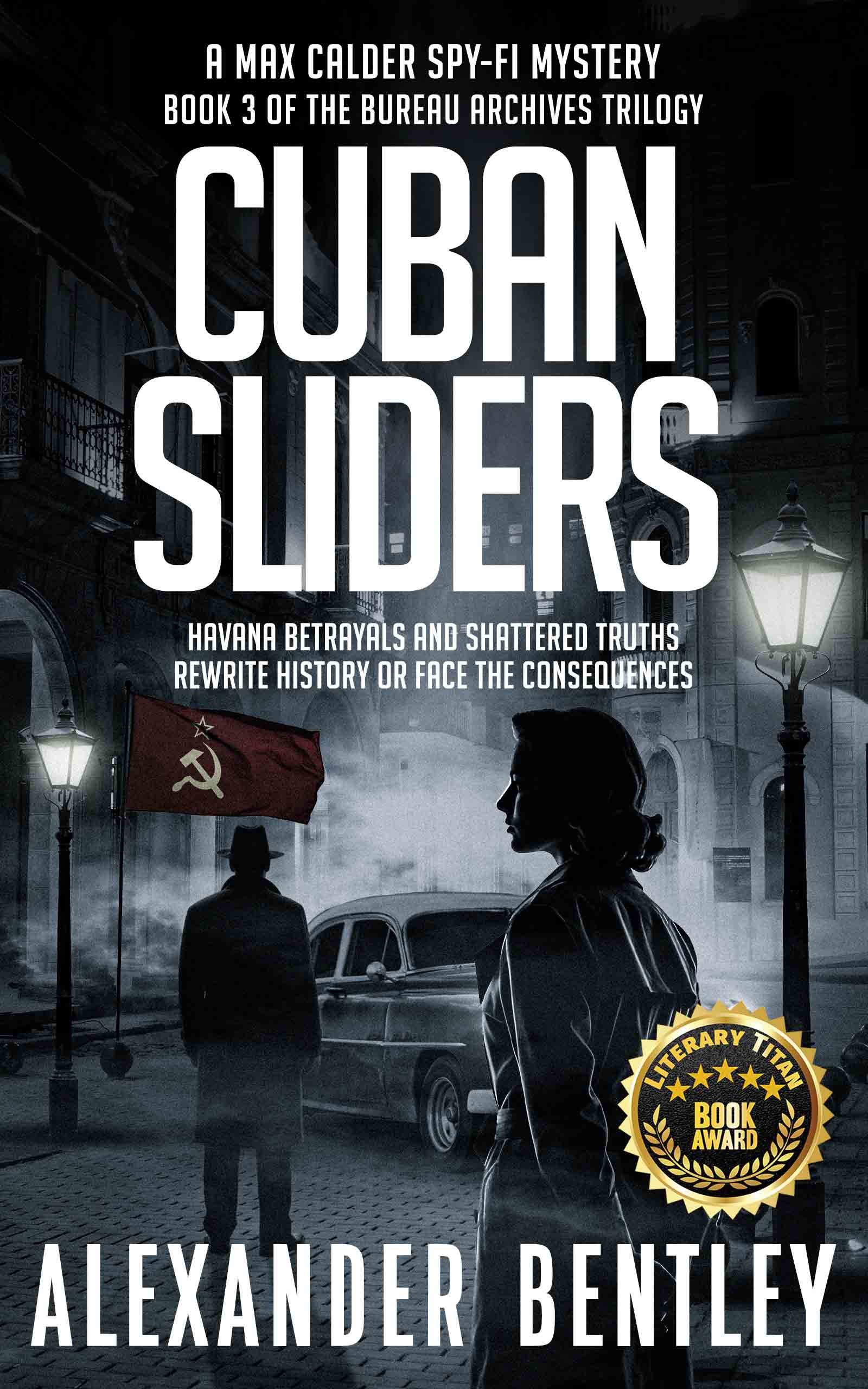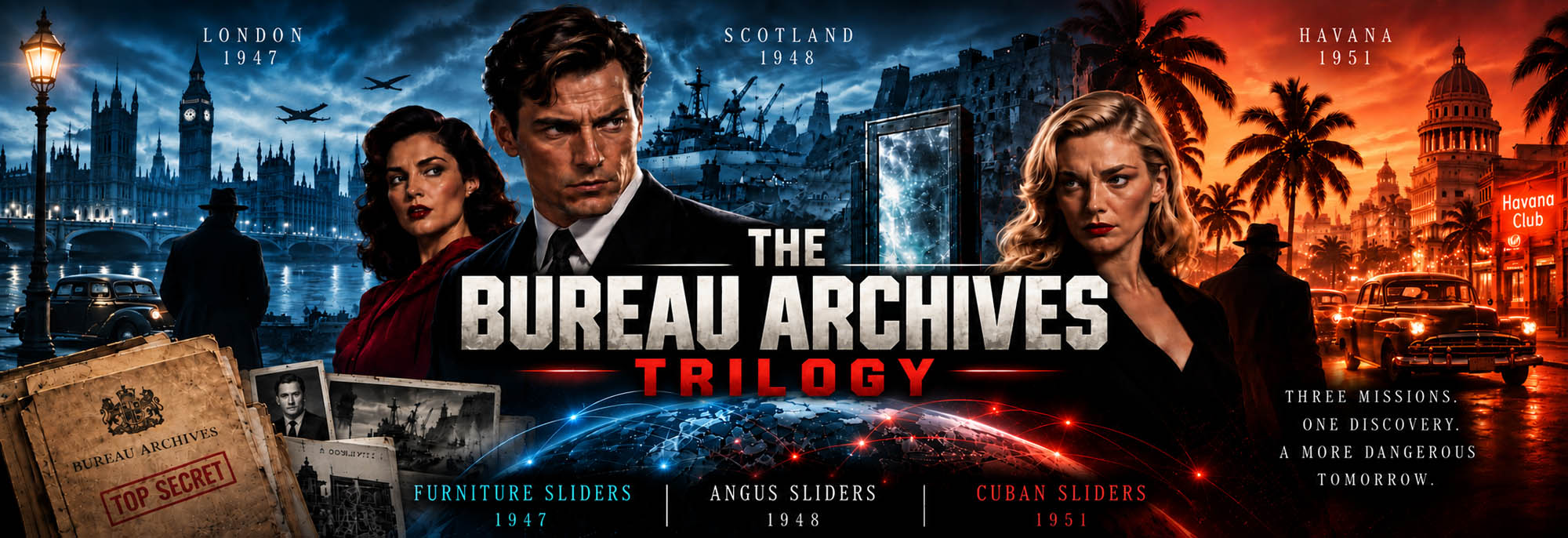
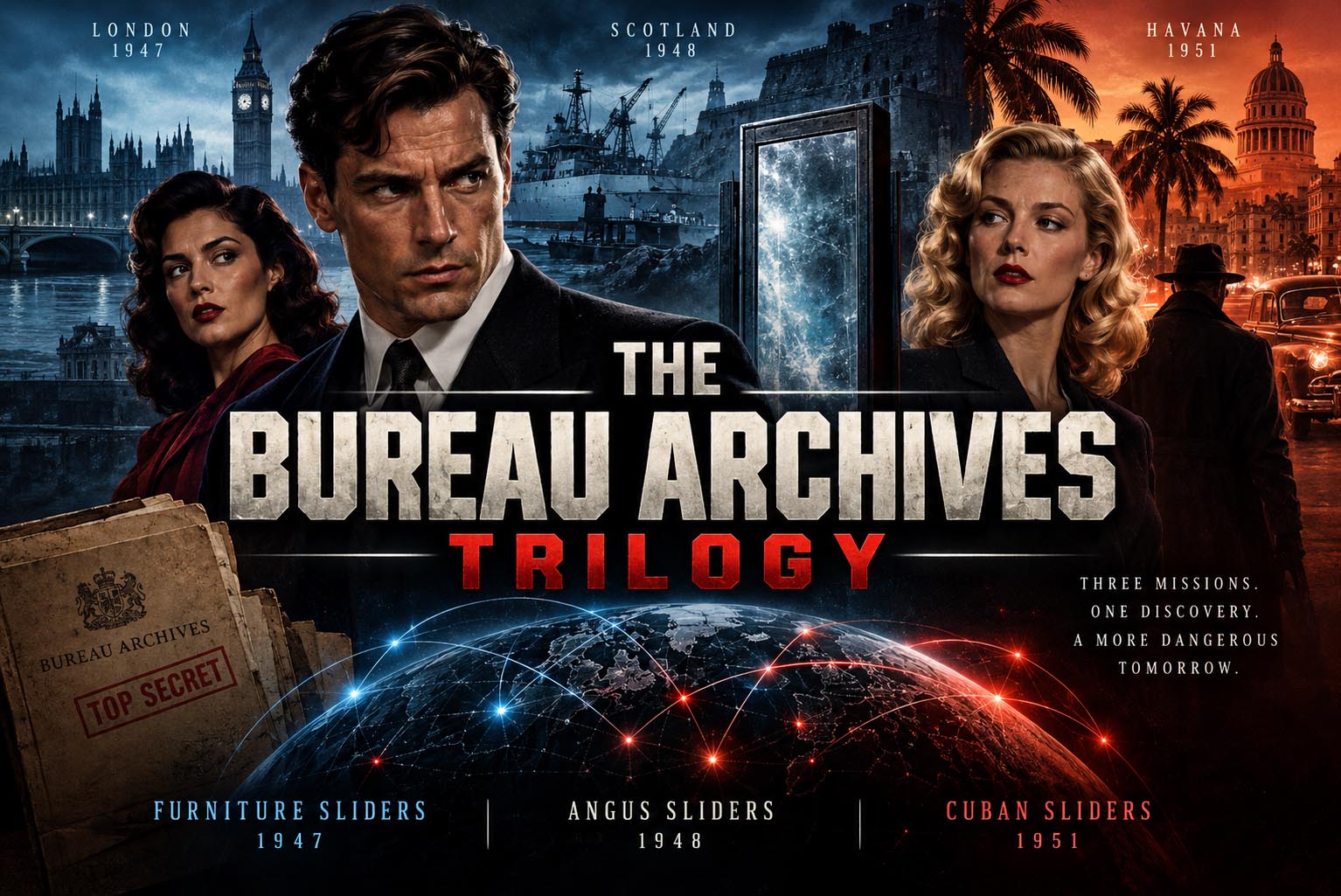
Alexander Bentley’s Bureau Archives Trilogy — Furniture Sliders, Angus Sliders, and Cuban Sliders is a Cold War spy-fi saga spanning the uneasy years after the Second World War, in which intelligence officer Max Calder discovers that the most dangerous weapon created during the war was not the atomic bomb, but an experimental technology capable of interfering with perception, memory, judgment—and ultimately human choice.
The story begins with Furniture Sliders in 1947, as Britain and its wartime allies adjust to a peace already hardening into another kind of conflict. Calder becomes involved in an investigation surrounding a classified wartime experiment known as the Mirror. Developed in secrecy and pursued by competing intelligence interests, the Mirror was intended to explore effects that appeared to challenge conventional ideas about time, causality and perception.
The experiments failed—or appeared to.
What they left behind is far more disturbing.
People exposed to the Mirror experience fractured memories, displaced perceptions and contradictory recollections of events. Individuals remember conversations that others insist never occurred. Sequences appear to change. Identities become uncertain. The resulting anomalies—eventually associated with the phenomenon of the Sliders—make it increasingly difficult for Calder to distinguish between what happened, what might have happened, and what he merely remembers happening.
Working amid the secretive world of British intelligence, Calder encounters Alicia Rayes, whose own involvement with the Mirror becomes inseparable from his investigation. Their relationship develops against a landscape of post-war London, clandestine departments and intelligence organizations already beginning to turn against yesterday’s allies.
The deeper Calder penetrates the operation, the more personal the mystery becomes. The Mirror has produced apparent duplicates, echoes and contradictory versions of individuals associated with it. Calder is forced to confront the possibility that even his own continuity cannot be trusted.
But the most important discovery is more subtle.
The Mirror has not created a practical means of traveling through time or rewriting the past. Its real legacy lies in the human mind. Exposure can alter memory, judgment and hesitation. It can affect the range of alternatives that a person is capable of considering.
The Mirror has not mastered time.
It has begun to interfere with choice.
Angus Sliders carries the investigation into 1948, as Calder and Rayes discover that the Mirror did not disappear with the events of the first novel.
Its technology has been concealed, transported and reconstructed.
The trail leads north into Scotland, including Rosyth and the increasingly secret world surrounding subsequent versions of the Mirror. What had initially appeared to be a contained wartime experiment is revealed as part of a much larger struggle. British, American and Soviet intelligence organizations understand that something extraordinary was created—and each wants to know whether it can be controlled.
Calder finds himself navigating two overlapping mysteries: who possesses the surviving technology, and what the Mirror actually does.
The distinction becomes crucial.
The apparent temporal effects that surrounded the original experiments increasingly prove misleading. The Mirror does not reliably transport people through time or permit history to be rewritten. Instead, its instability creates disturbances in cognition and perception so profound that they can feel like changes to reality itself.
That realization changes the strategic importance of the technology.
A weapon capable of changing history would be extraordinary.
A weapon capable of changing how human beings decide what history should become may be more useful.
The struggle surrounding the reconstructed Mirror therefore moves beyond scientific curiosity. Soviet intelligence, British interests and the emerging American intelligence establishment begin circling the technology, while individuals inside those institutions pursue agendas of their own.
Among the figures casting a growing shadow across the investigation is Kim Philby. His importance lies not simply in espionage or divided loyalty, but in his understanding of the new strategic environment. Information is no longer necessarily the decisive commodity. Controlling what people are capable of considering may matter more than controlling what they know.
Calder's investigation also forces him deeper into the problem of identity established in Furniture Sliders. The possibility of multiple or altered versions of people associated with the experiments means that evidence cannot always be trusted—and neither can memory.
By the conclusion of Angus Sliders, the Mirror has ceased to be merely a British secret.
The trail is moving outward.
And ultimately it points toward the Americas.
Cuban Sliders brings the trilogy into the early 1950s, culminating in Cuba and the political upheaval surrounding the 1952 coup.
By now, Calder's pursuit of the Mirror has become inseparable from the developing Cold War. What began in Britain as the remains of a failed wartime experiment has evolved through successive reconstruction attempts. The most advanced incarnation—Version Four—lies at the center of a clandestine struggle involving British, American and Soviet interests.
Calder and Rayes are joined by figures including Lucy Howard, while the American intelligence world introduces men such as James Angleton, whose instinctive distrust of appearances makes him particularly suited to a conflict in which identity, memory and motive can no longer be taken at face value.
The investigation leads eventually to Havana, where espionage and political instability provide the perfect environment for the Mirror's final evolution.
Here Calder discovers the real significance of everything that has happened since 1947.
The great breakthrough is not the Mirror itself.
It is what has been learned from it.
The technology has demonstrated that human judgment can be narrowed. Instead of forcing someone to accept a decision, it may be possible to progressively eliminate the alternatives that make disagreement possible. People still believe that they are choosing freely. Meetings still occur. Arguments may still be heard. Governments continue to operate.
But fewer possibilities survive long enough to become decisions.
This principle becomes the foundation of what will later be understood as Decision Locking.
Philby emerges as an important figure in this transition, not because he invented the process or controls some single machine, but because he recognizes what it represents. Espionage has traditionally been built around information: acquiring secrets, protecting secrets and deceiving an enemy about what is true.
Decision Locking suggests something different.
You do not have to persuade someone.
You do not even have to deceive them.
You merely have to make every alternative except one become progressively less thinkable.
Against the political instability of Cuba, Calder begins to recognize the terrifying strategic potential of that idea. Political events can appear entirely natural because no obvious coercion is required. Institutions create their own momentum. Fear encourages conformity. Strategic anxiety suppresses dissent. Resistance fragments.
By the time a decision is reached, everyone involved may sincerely believe that there was never another realistic choice.
The struggle surrounding Version Four brings Calder's personal and operational journey to its climax. The recurring problem of multiple versions, fractured memories and uncertain identities returns as the surviving Mirror technology destabilizes. Calder and his allies must prevent the experiment from becoming an operational system capable of extending its influence far beyond Cuba.
The Mirror is ultimately destroyed.
But destroying the machine does not destroy what the intelligence services have learned from it.
As the trilogy closes, Kim Philby's position collapses and he resigns from British intelligence, while Cuba demonstrates how political transformation can occur with remarkably little visible coercion when opposition is divided and decisions acquire an appearance of inevitability.
Calder, Rayes and Lucy are left confronting a disturbing conclusion.
They spent years believing they were fighting a machine that could interfere with time.
They were wrong.
The Mirror's greatest legacy is the discovery that uncertainty itself can be manipulated.
That realization provides the bridge from The Bureau Archives into the world that follows. Lucy's assessment, supported by Calder and Rayes, helps convince the surviving intelligence circle that destroying the Mirror has not eliminated the threat. The physical technology may be gone, but its effects—and the knowledge derived from them—remain.
The Office of Decision Integrity (ODI) is subsequently created to investigate precisely that danger.
And the question that began with Furniture Sliders is finally transformed.
The danger was never that somebody might learn how to change the past.
It was that somebody might learn how to make the future inevitable.
The trilogy's central progression is therefore:
Furniture Sliders — Can reality be trusted?
Angus Sliders — Can judgment be trusted?
Cuban Sliders — Can choice be trusted?
And beneath all three books lies the principle that will define the world beyond The Bureau Archives:
Time is not the weapon. Certainty is.