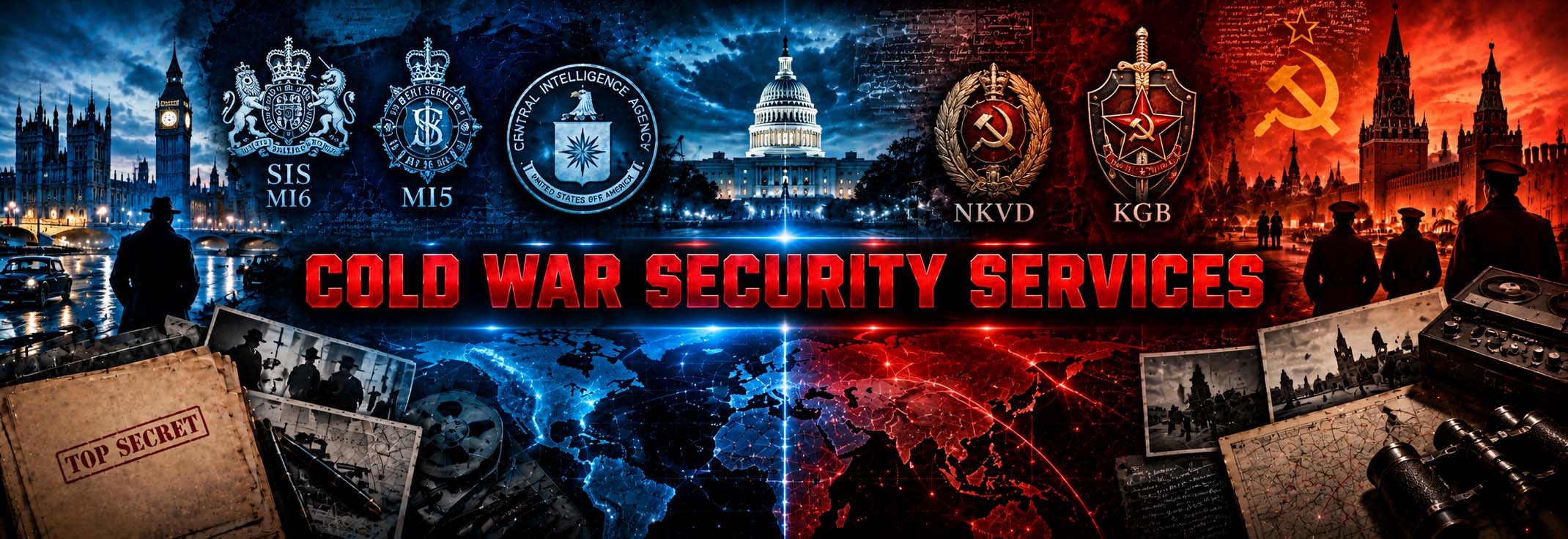
The Cold War was fought as much in the shadows as on the battlefield. Intelligence agencies recruited spies, infiltrated governments, stole scientific secrets and conducted covert operations that shaped international relations. Across Alexander Bentley's Bureau Archives Trilogy and The Consensus Files, real intelligence organizations operate alongside two fictional agencies created to confront scientific threats beyond the capabilities of conventional espionage.
Known informally as the Bureau, OTASI operates beyond the conventional boundaries of national intelligence organizations. Its secretive leadership, the Nameless Nine, oversees investigations into the Mirror, an experimental technology capable of disturbing time, identity and physical reality. Working through clandestine networks and selected intelligence officers, including Max Calder and Alicia Rayes, the Bureau attempts to prevent governments from exploiting discoveries whose consequences they cannot fully understand. Its greatest challenge is maintaining independence in a world where scientific knowledge has become an instrument of national power.
Established following the events of The Bureau Archives, ODI inherits the responsibility for monitoring the dangerous scientific legacy of the Mirror. Operating from Chancery Lane in London, under Director Miles Vickers, the organization focuses on Decision Locking—a technology capable of narrowing human judgment until disagreement disappears. Working with British, American and allied intelligence services, ODI investigates potential interference with political, military and institutional decisions. Giles Harrington and Lucy Howard become central figures in its operations as the struggle extends across the Cold War world.
Britain's Secret Intelligence Service, commonly known as MI6, conducts overseas intelligence operations and gathers information concerning foreign governments and threats to British security. During the early Cold War, SIS played a central role in monitoring Soviet activities, recruiting agents and protecting British strategic interests. Its history was complicated by Soviet penetration, most famously through Kim Philby and the Cambridge spy network. In the novels, SIS provides the professional background for several principal characters and frequently finds itself balancing national objectives against the concerns of OTASI and ODI.
MI5, Britain's Security Service, is responsible for protecting national security against espionage, sabotage and other domestic threats. Unlike SIS, its principal responsibilities concern security within the United Kingdom. During the Cold War, MI5 investigated Soviet intelligence networks, suspected communist infiltration and threats to sensitive government institutions. In The Consensus Files, its responsibilities sometimes overlap or conflict with those of SIS and ODI, particularly when questions of national security extend into Whitehall and Westminster.
Established in 1947, the CIA became America's principal civilian foreign intelligence organization. During the Cold War, it conducted espionage, intelligence analysis and covert operations intended to counter Soviet influence. Figures such as James Jesus Angleton feature in the novels, alongside fictional officers including Grant Baldwin and Daniel Mercer. The CIA's involvement with advanced scientific research creates recurring tensions between intelligence gathering, national security and the temptation to exploit technologies whose consequences remain uncertain.
The NKVD was a powerful Soviet organization responsible for internal security, policing, political repression and intelligence activities. During the Second World War, it played a significant role in counterintelligence and Soviet security operations. In 1946, the NKVD was reorganized into the Ministry of Internal Affairs (MVD), while state security functions were assigned to the Ministry for State Security (MGB). Its wartime legacy provides part of the historical background to Soviet intelligence activities depicted in The Bureau Archives.
Established in 1954, the KGB became the Soviet Union's principal state security organization, responsible for foreign intelligence, counterintelligence, internal security and political surveillance. Its operations extended across Europe and beyond as Moscow sought to protect Soviet interests and challenge Western influence. In The Consensus Files, Major Viktor Kolyadin represents the strategic ambitions of Soviet intelligence, pursuing scientific and political advantages that could fundamentally alter the balance of power.
SIS, MI5, the CIA, NKVD and KGB were genuine intelligence organizations whose activities helped shape the Cold War. OTASI and ODI are fictional creations, introduced to explore what might have happened had governments discovered technologies capable of challenging reality and influencing human choice.
Together, these organizations provide the intelligence framework for seven interconnected novels in which scientific ambition, political power and personal loyalty collide.
In a world built on secrets, the most dangerous intelligence may be the knowledge that changes how decisions are made.

Built by Alexander Bentley. Copyright © 2026 Alexander Bentley