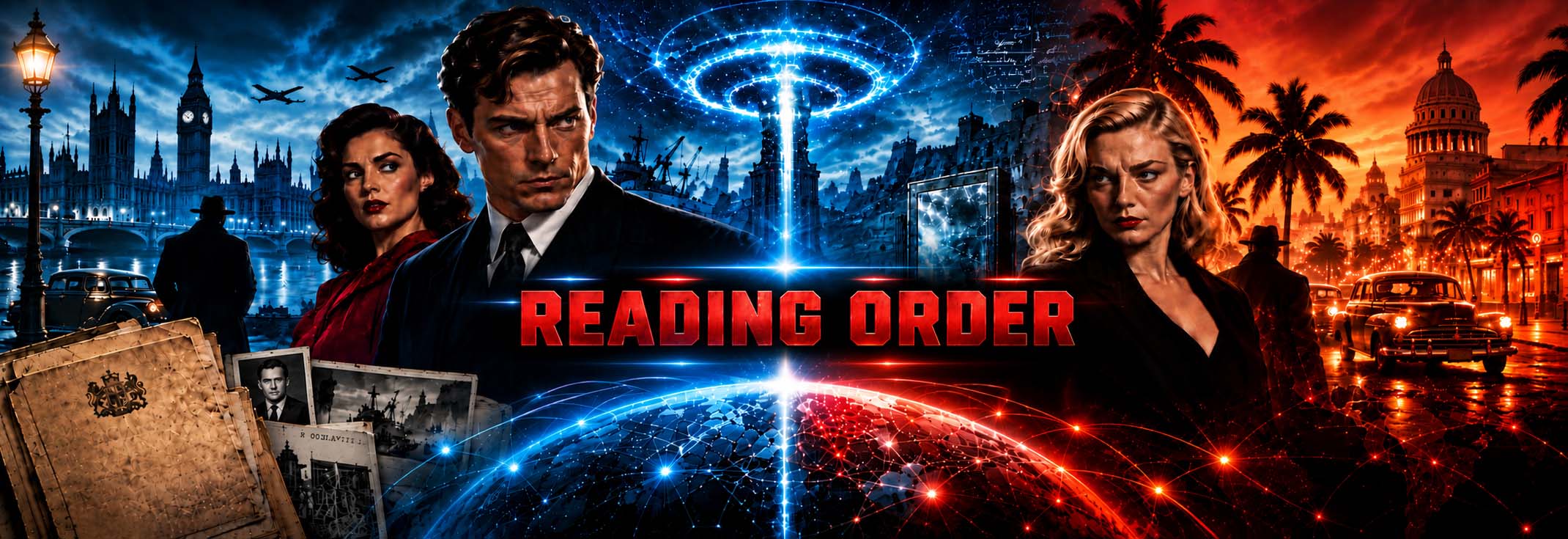
The Cold War was fought with spies, secrets, nuclear weapons, and the threat of global annihilation. But in Alexander Bentley's fictional world, another conflict unfolded beneath history's surface. It began with a technology capable of challenging the nature of reality itself and evolved into something potentially more dangerous: the ability to control human decisions.
Across two interconnected series, seven novels follow the intelligence officers, scientists, and political figures caught in a struggle over technology that could change not merely the balance of power, but the meaning of free will.
Both series can be read independently. For the complete experience, begin with The Bureau Archives trilogy and continue with The Consensus Files.
At the end of the Second World War, Allied intelligence discovers evidence of a scientific breakthrough with consequences far beyond military superiority. A mysterious apparatus known as the Mirror appears capable of disturbing the boundaries of time, identity, and physical reality.
British intelligence officer Max Calder, with a clandestine organization called the Office of Temporal Anomalies and Strategic Intelligence (OTASI) known simply as The Bureau, becomes entangled in a struggle involving MI6, the CIA, and Soviet intelligence. As the Mirror changes hands, its implications become increasingly dangerous. The technology promises extraordinary possibilities, but every attempt to control it produces consequences that its creators cannot fully understand.
The trilogy establishes the scientific discoveries, intelligence rivalries, and moral dilemmas that shape the world of The Consensus Files.
Click the book titles to go to the relevant 'Buy The Book' page.
In the aftermath of the Second World War, Max Calder and partner agent Alicia Rayes deal with a secret scientific project whose implications threaten to overturn conventional intelligence operations and accepted laws of physics.
Begin here for the complete seven-book story.
As rival intelligence services pursue the Mirror's secrets, Calder and Rayes discover that the technology's consequences extend beyond the laboratory. Questions of identity, loyalty, and reality become inseparable from the Cold War struggle.
The struggle surrounding the Mirror reaches its climax in Cuba. But the scientific knowledge the project generated cannot simply be destroyed, and its most dangerous legacy has yet to emerge.
Four years after the events of Cuban Sliders, the intelligence world faces a new danger.
The Mirror's scientific legacy has produced Decision Locking, a technology that narrows the choices available to the human mind until disagreement disappears. Those affected do not necessarily feel coerced. They believe the decision was their own.
The Office of Decision Integrity (ODI), based in London’s Chancery Lane and which has taken over from the old Bureau, monitors this threat and works to prevent its exploitation by governments and intelligence agencies.
At the center of the series are British intelligence officers Giles Harrington and Lucy Howard, whose investigations carry them from American research installations to the Kremlin, Budapest, Algiers, Paris and Westminster.
Each novel follows a different stage in the development of Decision Locking, moving from experimental apparatus to the possibility that entire political institutions can become instruments of manufactured consensus.
When unexplained incidents at an American airbase lead Giles Harrington and Lucy Howard toward a secret scientific program, they discover a technology capable of influencing human judgment. As the United States and Soviet Union confront its implications, the struggle for control threatens to transform Cold War strategy.
This is also an excellent starting point for readers who prefer to begin with The Consensus Files.
As the Hungarian uprising challenges Soviet authority and NATO confronts its own strategic divisions, Giles and Lucy investigate whether governments' apparent decisions are being influenced by forces beyond ordinary political calculation.
France approaches political collapse as the Algerian crisis threatens the Fourth Republic. A new generation of Decision Locking technology raises the possibility of influencing decisions across great distances, placing the future of French democracy at risk.
As Cold War tensions intensify from Berlin to Westminster, the ODI confronts its most disturbing possibility: that institutions can begin suppressing alternatives without the direct intervention of any Decision Locking apparatus.
The final novel asks whether a political system can become so conditioned toward agreement that it no longer recognizes the choices it has lost.
Start with Furniture Sliders.
Read all seven novels in chronological order, beginning with the origins of the Mirror and following the evolution of its technology into Decision Locking.
This is the recommended route for readers who enjoy connected fictional universes, recurring characters, and long-running intelligence conspiracies.
Start with The Teller Threshold.
The Consensus Files introduces a new principal cast, a new intelligence organization, and a new phase of the Cold War conflict. Readers can enter the story here without first reading The Bureau Archives trilogy.
Those who subsequently return to the earlier novels will discover the origins of the technology, organizations, and historical connections that underpin the later series.
From the Mirror to Decision Locking
The Mirror is the central scientific mystery of The Bureau Archives. Its experiments challenge the stability of physical reality, and the intelligence services pursuing it gradually discover that its underlying principles may have applications beyond the original apparatus.
Decision Locking emerges from that scientific legacy. Rather than manipulating physical reality directly, it interferes with the alternatives available to human judgment.
The distinction is fundamental. The Mirror threatens the nature of reality. Decision Locking threatens humanity's ability to choose.
From the Bureau to the ODI
The Bureau operates in the shadows of the early Cold War, attempting to contain technologies that conventional intelligence services cannot adequately understand or control.
Following the events of Cuban Sliders, a new organization emerges: the Office of Decision Integrity. The ODI inherits aspects of the Bureau's mission but faces a different challenge. Its purpose is not merely to contain dangerous scientific equipment, but to protect the integrity of human decision-making.
From Max Calder and Alicia Rayes to Giles Harrington and Lucy Howard
Max Calder's and Alicia Rayes’ investigations establish the world and its underlying scientific dangers. Giles Harrington and Lucy Howard inherit the consequences.
Although the principal characters change, the two series share a continuous fictional history, recurring intelligence figures, overlapping institutions, and a central moral question:
Is a world without conflict worth the price of a world without choice?
The novels unfold against real Cold War events, including the emergence of nuclear deterrence, the Hungarian uprising, the collapse of France's Fourth Republic, and the Berlin crisis.
Historical figures and political events are interwoven with fictional intelligence operations and speculative scientific developments.
The history provides the setting. The fictional technology changes what may have happened behind closed doors.

Built by Alexander Bentley. Copyright © 2026 Alexander Bentley