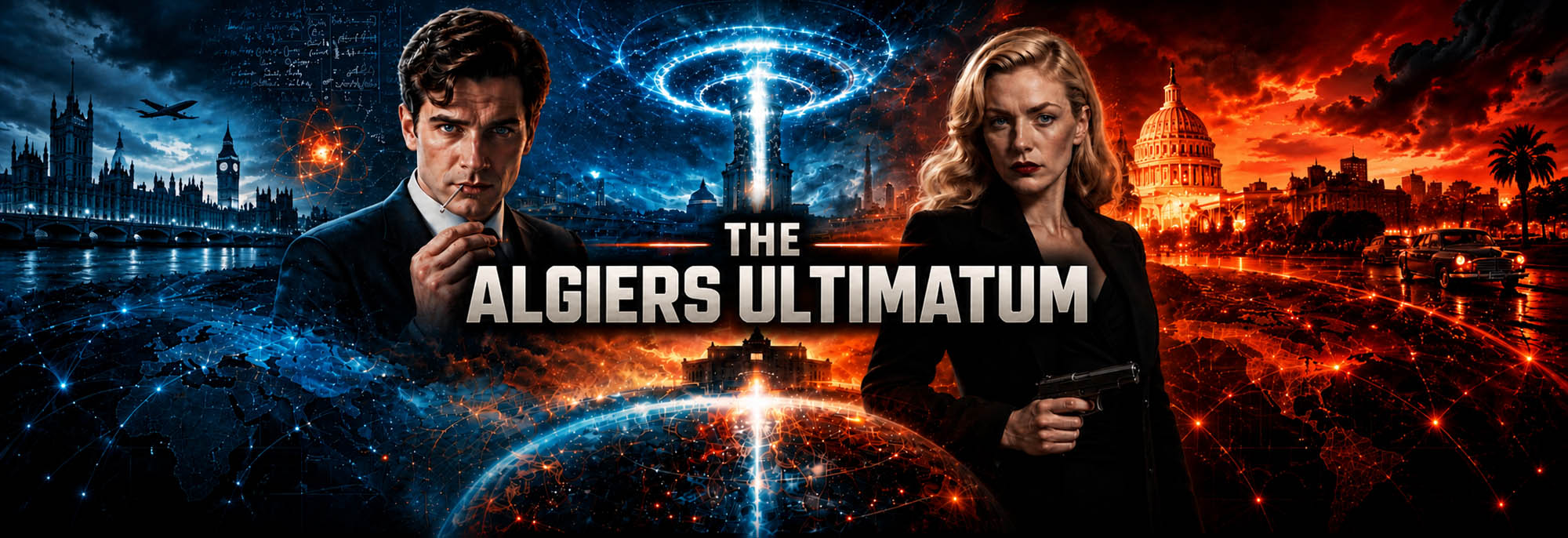
France, 1958. The Fourth Republic is approaching collapse. The war in Algeria has divided the nation, weakened successive governments and brought the French military into increasingly open conflict with the political leadership in Paris. As unrest spreads through Algiers and the possibility of a military intervention grows, the future of France hangs in the balance. But behind the familiar struggle between politicians, generals and revolutionaries, another conflict is developing—one in which the decisions that determine a nation's future may not be entirely its own.
For British intelligence officers Giles Harrington and Lucy Howard, the crisis presents a disturbing new dimension to a threat they have encountered before. Decision Locking, a technology capable of narrowing human judgment until disagreement disappears, has already demonstrated its potential to influence individuals and institutions. Now intelligence reports suggest that its underlying principles may have advanced beyond the limitations of the original apparatus, raising the possibility that political decisions could be influenced on a far greater scale.
Operating under the authority of London's Office of Decision Integrity, Giles and Lucy are drawn into a dangerous investigation spanning Algiers, Paris and the intelligence establishments of several NATO allies. What begins as an attempt to identify suspicious scientific activity develops into a struggle involving clandestine communications, competing intelligence operations and political factions whose objectives are often impossible to distinguish from their public declarations.
In Moscow, KGB Major Viktor Kolyadin watches the French crisis with particular interest. Patient, analytical and convinced that the Cold War will ultimately be determined by the ability to influence political outcomes, Kolyadin sees France as more than another opportunity to weaken Western unity. The instability of the Fourth Republic offers a rare opportunity to study how governments, military institutions and public opinion respond when the range of available choices begins to narrow.
Meanwhile, France's political leadership confronts an increasingly desperate situation. In Algeria, military commanders demand decisive action while the government in Paris struggles to maintain authority. Charles de Gaulle, the wartime leader whose return to power is becoming a subject of intense national debate, stands at the centre of competing expectations about France's future. Yet the apparent momentum toward a political settlement conceals divisions that could push the country toward constitutional breakdown or civil conflict.
Within NATO, the implications extend far beyond France. A political collapse in Paris could threaten the alliance's strategic cohesion, disrupt military planning and alter the balance of power in Western Europe. Eleanor Whitcombe, working through the Office of Decision Integrity's connections with NATO and SHAPE, confronts the difficult task of separating legitimate political developments from evidence of possible interference. CIA officer Daniel Mercer brings a different perspective, questioning whether the unusual patterns emerging from intelligence reports represent deliberate manipulation or simply the unpredictable behavior of governments under extreme pressure.
For Giles and Lucy, the investigation becomes increasingly dangerous as they move between the streets of Algiers, the political corridors of Paris and covert operations conducted beyond the reach of ordinary diplomatic scrutiny. Their adversaries are not always identifiable, their allies do not necessarily share their objectives, and every apparent breakthrough raises further questions about the technology they are pursuing. Even when evidence suggests that decisions are being influenced, proving interference—and determining who is responsible—may be more difficult than preventing its consequences.
As France approaches a moment of national reckoning, Giles and Lucy must confront a troubling possibility: that a political crisis does not have to be created to be exploited. It may be enough to influence the choices made by those already caught within it. And when every faction believes it is acting freely, distinguishing political conviction from manufactured certainty becomes an intelligence problem unlike any they have previously encountered.
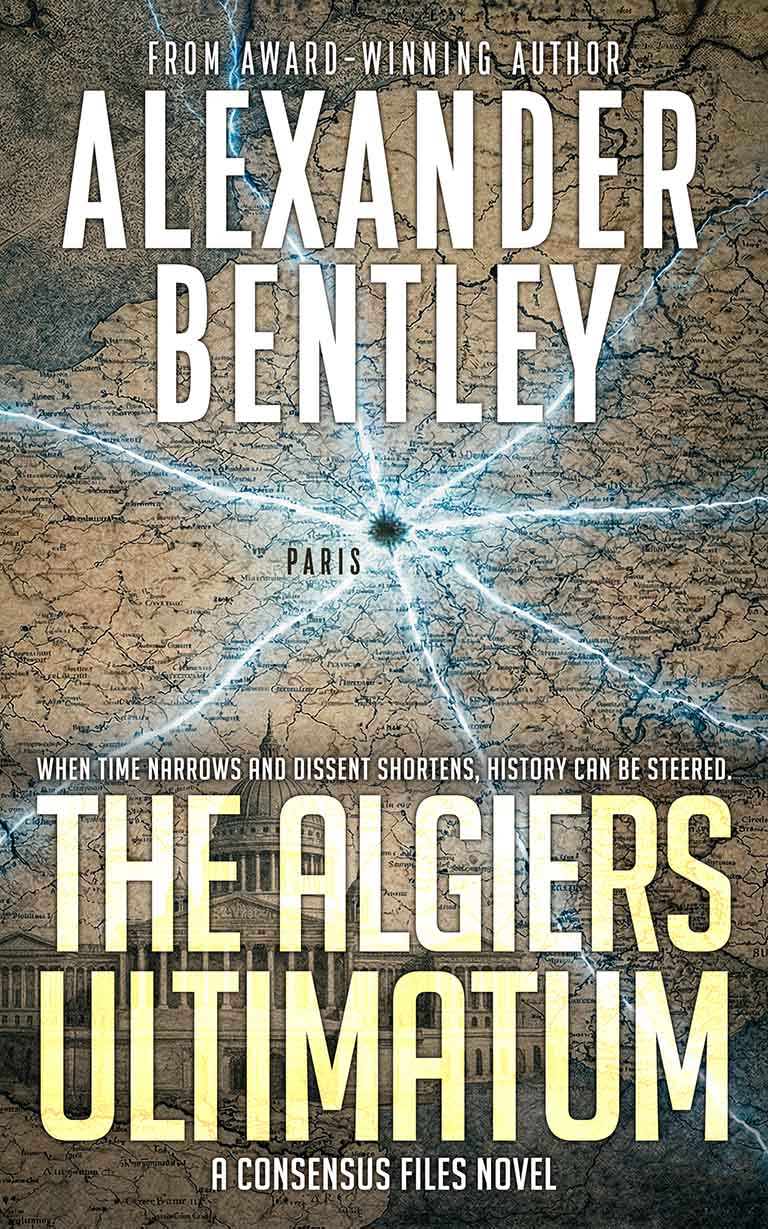
The Algiers Ultimatum, the third novel in The Consensus Files, combines the historical crisis that brought France's Fourth Republic to its end with Cold War espionage, covert field operations and speculative quantum science. Against a backdrop of military rebellion, political intrigue and international intelligence rivalry, Alexander Bentley explores the vulnerability of democratic institutions when scientific ambition and political power converge.
When a nation's future hangs on a handful of decisions, what happens if someone else can determine which choices remain possible?
Built by Alexander Bentley. Copyright © 2026 Alexander Bentley