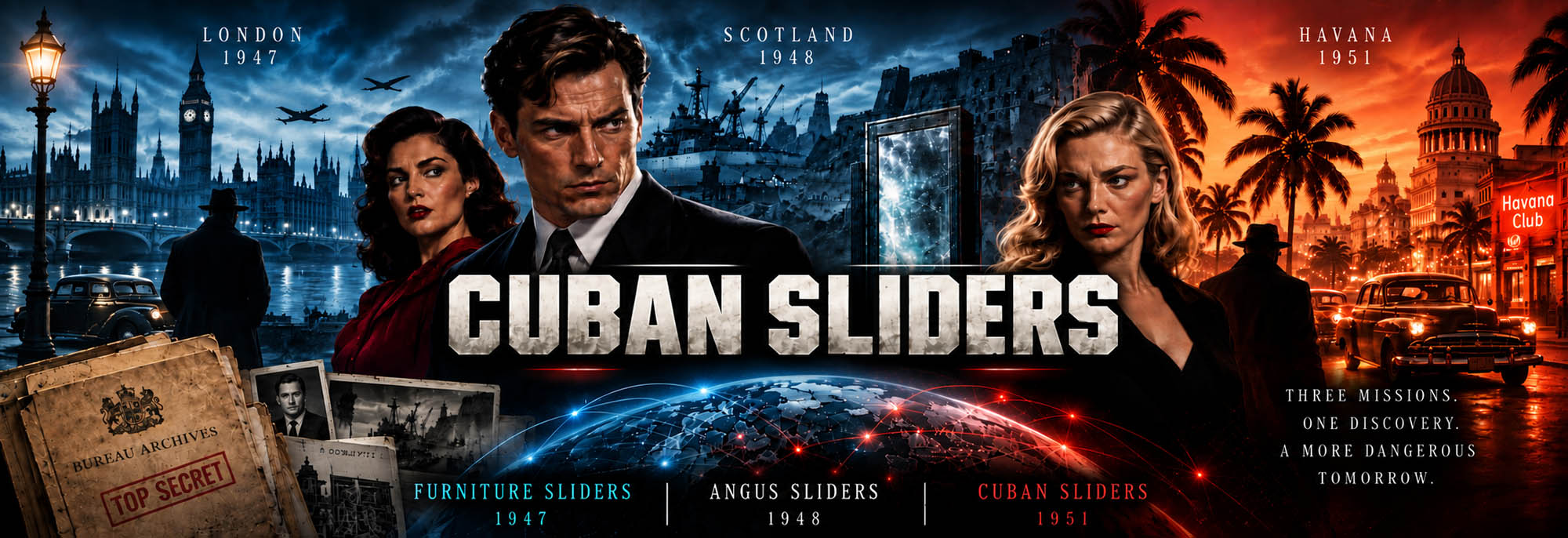
Cuban Sliders follows a former operative who is sent to 1951 Havana, where a time-fracturing technology has evolved into a machine that locks the future into a single path, and he needs to stop it before it is too late. “Decision Locking” is deeply unsettling. Where did that idea originate?
It began with a quieter question than people expect. We spend a great deal of time worrying about machines that control minds. That’s a familiar fear. It belongs to dystopia. It’s theatrical.
What interested me more was something subtler: what if no one controlled you at all—but the range of available futures narrowed before you even knew you were choosing?
Decision Locking came from observing how institutions behave under pressure. In intelligence work, in politics, in war planning—there’s always a desire to remove friction. Debate is messy. Delay is dangerous. Consensus feels efficient.
So I asked myself: what if you could remove dissent without coercion? Not by force, not by persuasion, but by altering the timing of thought itself. That is more frightening than brainwashing. Most moral failure doesn’t occur in chaos. It occurs in clarity.
Decision Locking doesn’t insert ideas. It doesn’t rewrite personality. It simply ensures that one conclusion arrives first—and that all others arrive too late to matter.
The technology in Cuban Sliders is speculative. However, the impulse behind it is not. We are always tempted by certainty, especially when the stakes are high. The novel just pushes that temptation to its logical extreme.
How has Max changed since the first book, and how has the Mirror evolved across the trilogy?
Max, in the first book, is disoriented. He’s a man trying to survive an anomaly. The Mirror is something external—dangerous, mysterious, almost mythic. He reacts to it.
By Cuban Sliders, Max understands that the real danger isn’t the physical distortion of time. It’s the ethical distortion of responsibility. Max isn’t heroic in the traditional sense. He’s not decisive. He’s not ideologically pure. What he does possess is hesitation. That hesitation becomes a form of resistance.
He’s become more deliberate. More haunted. Less reactive. At first, he wants to repair the fracture. Later, he realizes that fractures are sometimes honest. It’s false smoothness that frightens him. I think Max survives because he refuses to reach conclusions too quickly.
In the first book, the Mirror bends time. In the second, it destabilizes identity. In the third, it stops pretending to be about physics at all.
By Cuban Sliders, the Mirror has become infrastructural. It isn’t just a device. It’s an influence. A method. A way of structuring decisions. And that evolution mirrors Max’s own realization: the enemy isn’t time travel. It’s inevitability. And Max doesn’t trust it.
The book seems deeply concerned with choice. Was that always central, and were you exploring power as control over time, or over people?
Choice was always the center. But not in the heroic sense. I’m less interested in whether someone chooses bravely than in whether they are allowed to choose slowly. I’m drawn to the moment after the decision—when a character realizes something irreversible has just occurred.
The trilogy examines two kinds of power: Power over time and power over people. The unsettling truth is that they converge.
If you control the timing of decisions, you control the outcome. Not because you force anyone, but because you compress the space in which doubt lives. And doubt is where moral weight accumulates.
So yes, the books are about time. But they’re also about institutions that prefer efficiency to accountability. About systems that reduce friction in the name of progress. And convenience, historically, has been far more transformative than malice. I wanted readers to feel unease at the smoothness of how things play out. What sounds like it might be a good idea actually isn’t!
Do you see yourself returning to this world someday?
Yes.
Not because I think there are any loose ends. But because the core question hasn’t gone away. It hasn’t ended. One of the misconceptions about the early Cold War is that it was purely ideological theater. In reality, it was procedural. Committees. Authorization chains. Redundancy systems.
The hydrogen bomb wasn’t just a weapon—it was a decision problem. Once destructive capability exceeded moral comprehension, the question became: who decides, and how?
The next novel, Teller Threshold, moves into the early Cold War thermonuclear era and examines what happens when Decision Locking intersects with nuclear doctrine. If the hydrogen bomb represents destruction at scale, Decision Locking represents certainty at scale. The combination is potentially highly volatile.
More importantly, what happens when a room tasked with deciding on irreversible action is deprived of dissent? Decision Locking is fictional, but the desire to remove dissent from high-stakes environments is very real. The ethical tension still feels alive and worthy of further exploration. The stakes become explicit: what happens if the most destructive weapon ever built is paired with a technology that eliminates dissent in the room deciding whether to use it?
What interests me now is whether a society can fracture dissent so thoroughly that it mistakes silence for stability. I don’t think I’m finished with that question. It isn’t about control of territory or control of weapons. The deeper anxiety is about control of outcomes. It’s not about expertise overriding democracy—it’s about timing overriding deliberation. The whole subject feels like it fits well with Cold War noir-style espionage storytelling!