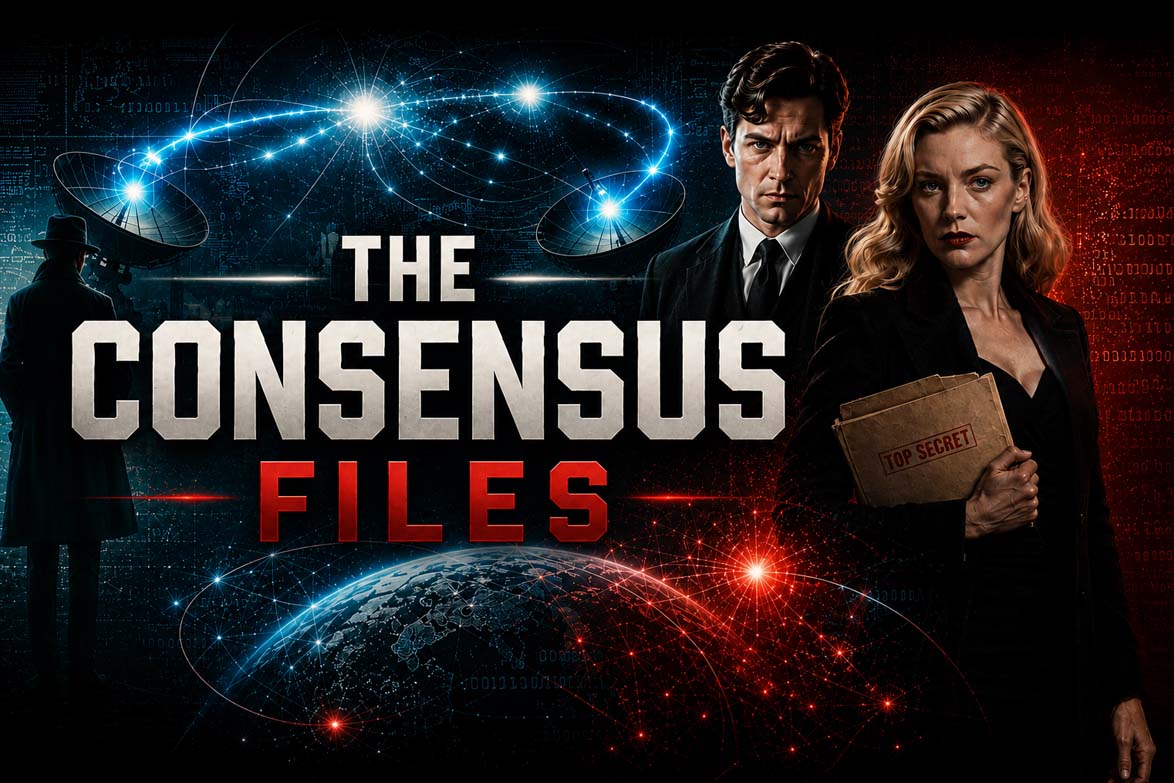
The Consensus Files reimagines the Cold War not as a contest solely of weapons or territory, but as a struggle over decision velocity. Nuclear arms redraw borders. Alignment redraws history.
By the final novel, the world appears stable once more. But beneath that stability lies a question that lingers beyond the Cold War: If agreement can be accelerated — and speed becomes strength — how long does freedom have to argue?
Between 1955 and 1962, as the Cold War hardened into permanent tension, intelligence services on both sides of the Iron Curtain discovered something more destabilizing than nuclear weapons. Not a bomb. Not a missile. A method.
The Consensus Files follows the evolution of a technology capable of compressing dissent at critical moments of decision — accelerating agreement within rooms, governments, alliances, and, eventually, democracies themselves.
Across five interconnected geopolitical crises, the series traces how the weaponization of consensus reshapes the architecture of global power. The series escalates in scale:
As the United States races to perfect the hydrogen bomb, a parallel danger slips out of laboratory shadows: a Mirror-derived temporal technology capable of erasing disagreement in a room. Decision Locking. When a flight test at Edwards AFB produces a brief, rectangular shimmer in the sky, Office of Decision Integrity operatives Lucy Howard and Giles Harrington are dispatched under Commerce cover to discover what—and who—has weaponized that shimmer.
At a laboratory in Livermore, California, physicist Edward Teller immediately recognizes the stakes. The same precision that makes thermonuclear yields controllable can also turn into a tool for building consensus and removing dissent. Teller becomes an uneasy ally, offering Lucy and Giles technical insight and access—if they agree to his strict rule: keep the technology under institutional control and never demonstrate it in rooms where decisions are made.
Opposing them is CIA Special Projects chief Baldwin of the CIA’s Office of Scientific Intelligence, whose desire for a proof-of-concept demo stems from a belief that political will can be manufactured as easily as a data point. Baldwin’s ambition clashes with ODI’s containment strategy; his attempts to control rooms and military exercises are sabotaged, but each disruption reveals more actors who covet the technology. Baldwin is at odds with CIA leader James Angleton.
On the other side of the conflict, Soviet rezident Viktor Kolyadin orchestrates a methodical, industrial campaign to acquire Decision Locking technology and exportable components. The Mirror-derived tech moves through secret channels—from warehouses in California to Guatemala and then to Murmansk—where the Soviets turn improvised prototypes into an operational system. Harrington and Howard track that pipeline from desert ranges to San Diego warehouses, across the Atlantic, and into Arctic wastelands; Baldwin slips between them like a ghost, sometimes an ally, sometimes a seller.
As the story escalates, the novel centers on a moral dilemma: evidence of a functioning permanent Decision Locking Node in Murmansk forces Harrington, Howard, and Teller to consider options that would have been unthinkable—exposing the operation to international oversight and risking leakage, attempting targeted sabotage and risking war, or becoming guilty of the very abuses they oppose. Their compromise—securing Teller’s technical safeguards, pushing for joint custody, and implementing reversible sabotage—buys time but no certainty. The climax concludes with a tense, bipartisan confrontation that prevents immediate catastrophe but leaves the world changed: the physical Node is contained for now, technology is sequestered, and rules are written—but the system’s existence has already reshaped strategy, trust, and bureaucracy.
Teller Threshold is a Cold War noir: sparse, procedural, and tense. A morally restless Cold War thriller that asks: when you can bend consensus, who has the right to decide? It explores the ethical clash between science and statecraft—how tools that make instruments precise can be repurposed to make men obedient—and the fragile boundary between prevention and preemption. Giles Harrington and Lucy Howard are maintenance agents in a new kind of arms race: their victories are administrative—locks, returns, custody chains—and their triumphs are preventative rather than cinematic. Edward Teller serves as the moral compass and technical safeguard, pragmatic and blunt; Baldwin and Kolyadin embody ambition and patience, respectively, two facets of the same desire to control outcomes.