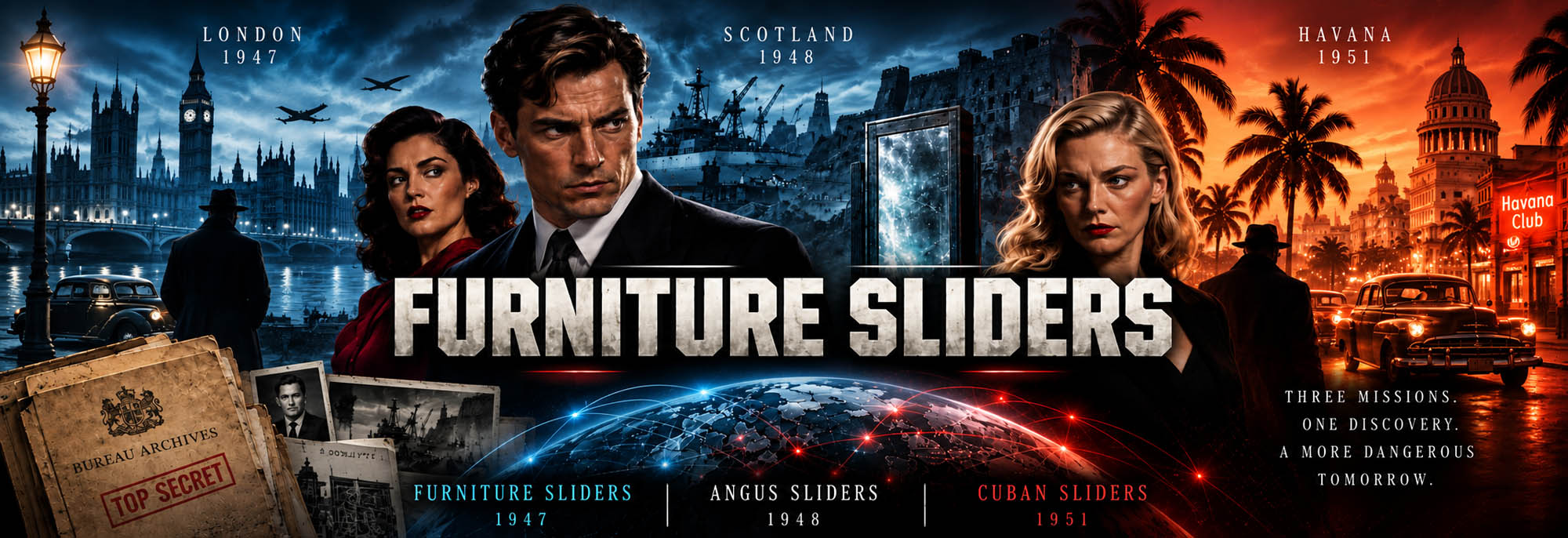
The year is 1947. The Second World War is over, but peace has brought little certainty. Europe is struggling to rebuild, the wartime alliance between Britain, the United States and the Soviet Union is disintegrating, and intelligence services are already preparing for a new confrontation. Behind the emerging Cold War, however, lies a secret more dangerous than anything the victorious powers have acknowledged: an experimental technology that appears capable of challenging the fundamental laws of reality.
Max Calder, a former British intelligence officer, has withdrawn from the clandestine world that dominated his wartime career. Living quietly in New York, he hopes to leave behind the compromises, betrayals and unanswered questions of his past. But his carefully constructed existence is interrupted by the unexpected arrival of Alicia Rayes, a resourceful intelligence operative once known by the codename Artemis.
Rayes brings disturbing news concerning the Mirror, a mysterious apparatus developed through classified wartime research. Its experimental effects have never been fully explained, and the intelligence surrounding it is fragmented, contradictory and closely guarded. Now evidence suggests that individuals with dangerous ambitions are attempting to locate and exploit the technology.
For Calder, the Mirror represents more than an unresolved intelligence operation. His previous encounters with the project have left him with troubling gaps in his memory and questions about events he cannot fully reconstruct. Rayes's arrival forces him to confront a past he believed he had escaped, while raising the possibility that some of his most firmly held recollections may be unreliable.
Their investigation takes them from New York to the divided intelligence world of post-war Europe. In Vienna, a city occupied by four Allied powers and already becoming a battleground for espionage, Calder and Rayes encounter a network of informants, former wartime operatives and competing intelligence interests. Each appears to possess part of the truth, but determining which information can be trusted becomes increasingly difficult.
The trail leads onward to Prague, where political tensions and the growing influence of Soviet intelligence create an atmosphere of suspicion and uncertainty. As Calder and Rayes pursue evidence connected to the Mirror, they find themselves caught between rival organizations whose objectives remain concealed behind layers of deception.
Their search eventually extends beyond Europe to South America, where the cities of Montevideo and Buenos Aires, and the mountainous approaches to the Andes, provide a different setting for the same dangerous contest. Wartime loyalties have become uncertain, clandestine networks operate across national boundaries, and individuals with scientific knowledge of extraordinary potential are valuable prizes in the emerging struggle between East and West.
As the investigation develops, Calder begins to question not only the motives of those pursuing the Mirror but also the reliability of his own judgment. Memories surface without explanation. Apparently straightforward evidence produces contradictory conclusions. People who should be allies conceal information, while others appear to know more about his past than he does himself.
Working together, Calder and Rayes must navigate a world in which conventional intelligence methods offer increasingly uncertain answers. Their relationship is tested by the demands of an investigation where personal trust may be as important as professional skill, and where the distinction between scientific discovery and strategic exploitation is becoming dangerously blurred.
At the centre of the mystery remains the Mirror itself. What was its original purpose? Why has its existence been concealed? And what might happen if a government or intelligence organization succeeds in turning an unpredictable scientific experiment into an instrument of power?
Furniture Sliders, the first novel in The Bureau Archives Trilogy, combines Cold War espionage, international intrigue and speculative quantum science in a thriller that moves from post-war New York and the divided cities of Europe to the clandestine networks of South America. Against a background of shifting alliances, compromised loyalties and scientific ambition, Alexander Bentley explores the fragile relationship between memory, identity and the nature of reality.
When the past cannot be trusted and reality itself becomes uncertain, how can anyone know which side they are really on?

Built by Alexander Bentley. Copyright © 2026 Alexander Bentley