This section provides official book descriptions and three authorized synopsis lengths for every novel: approximately 100, 300 and 500 words. The material has been prepared for use by journalists, reviewers, broadcasters, booksellers, literary websites, event organizers and other media professionals.
Each synopsis is designed to introduce the story, its historical setting, principal characters and central conflict without revealing significant plot twists or the outcome of the novel.
All descriptions and synopses published in this section are authorized for reproduction in editorial coverage and publicity relating to Alexander Bentley's books, subject to the usage guidelines below.
Select a series or individual book and copy the version best suited to your publication.
The synopses and complete book descriptions for The Budapest Reversal, The Algiers Ultimatum, and The House Protocol will be added when they publish.
Click the book titles to go to the relevant 'Buy The Book' page.
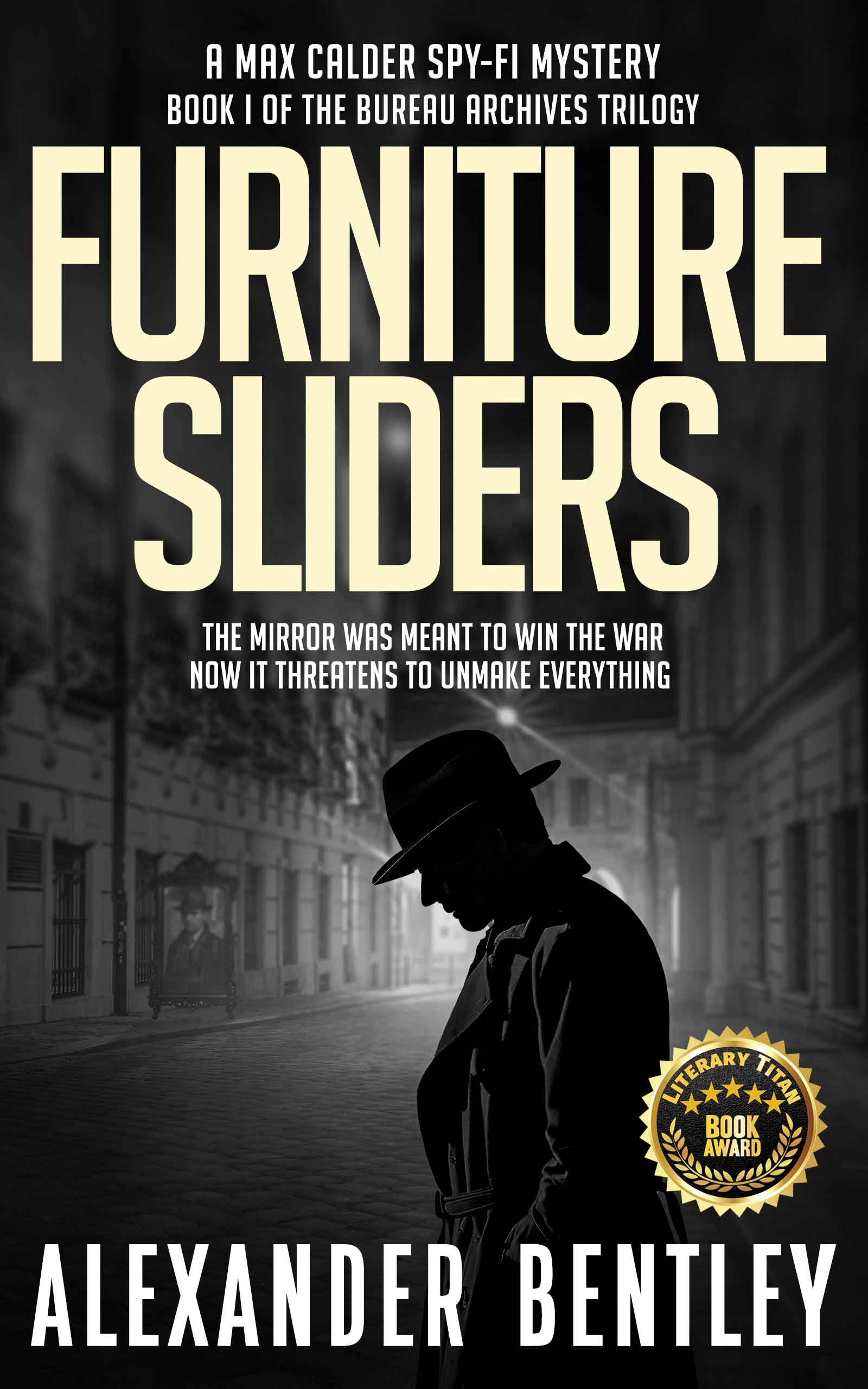
When former British intelligence officer Max Calder is approached by a mysterious woman who knows more about his past than he does, he is drawn back into a clandestine organisation known as the Bureau.
His assignment: locate a missing scientist whose experimental technology could transform the balance of power between East and West.
But Calder's memories are unreliable, his enemies are difficult to identify, and the mysterious Mirror appears capable of disturbing time itself.
As the Cold War begins, Calder must uncover the truth before a dangerous scientific discovery falls into Soviet hands.
In New York, former British intelligence officer Max Calder is approached by an enigmatic woman who claims to know him from an organization he can barely remember. Calling herself Artemis, Alicia Rayes brings news of a missing scientist, a secret wartime experiment and a mission that Calder may already have undertaken.
The scientist is Dr. Emil Krane, a brilliant and dangerous researcher whose work on an experimental apparatus known as the Mirror has attracted the attention of competing intelligence services. Once associated with a clandestine organization known as the Bureau, Krane has resurfaced in Vienna, apparently working with Soviet interests.
Calder's assignment seems straightforward: find Krane and prevent his research from falling into the wrong hands.
But the Mirror is no ordinary scientific invention. Developed from experimental theories concerning quantum mechanics and the manipulation of time, it appears capable of producing extraordinary disturbances in human perception, memory and reality itself.
For Calder, these effects are disturbingly personal. Fragments of forgotten missions intrude upon his present. Familiar people seem like strangers. Events he cannot recall nevertheless appear to have shaped his life.
As his investigation moves through the divided cities and uncertain alliances of postwar Europe, Calder must navigate rival intelligence networks, former Nazi scientists, Soviet operatives and the secretive organization that once employed him. His uneasy partnership with Artemis becomes increasingly important as the distinction between trusted ally and concealed adversary grows less certain.
Combining historical espionage with speculative science, Furniture Sliders introduces a Cold War in which the greatest threat may not be a new weapon, but a technology capable of changing the very nature of history.
And for Max Calder, discovering the truth may mean confronting a past he no longer remembers.
Europe lies divided between competing political systems. Former allies have become suspicious adversaries. Intelligence agencies are recruiting scientists, recovering secret research and preparing for a confrontation that threatens to define the postwar world.
In New York, former British intelligence officer Max Calder is living an uncertain existence, troubled by gaps in his memory and fragments of experiences he cannot explain. His past returns unexpectedly when a mysterious woman approaches him with information about a clandestine organisation known as the Bureau.
The woman calls herself Artemis. She insists that she and Calder have worked together before, although he has no recollection of their partnership. She also brings news of a dangerous development: Dr. Emil Krane, a scientist associated with a secret wartime research programme, has resurfaced in Vienna and appears to be collaborating with Soviet interests.
Krane's research concerns an experimental apparatus known as the Mirror.
Originally developed within a highly classified scientific program, the Mirror exploits speculative principles of quantum mechanics and temporal displacement. Its potential extends far beyond conventional military technology. Under certain conditions, it appears capable of disturbing the relationship between time, memory and physical reality.
For the intelligence services, such a discovery offers extraordinary possibilities. For those exposed to its effects, the consequences may be considerably more personal.
Calder knows something about the Mirror, but much of that knowledge has disappeared from his memory. As he begins investigating Krane, unsettling fragments of his former life intrude upon the present. Places he has never visited seem familiar. People claim relationships he cannot remember. His own recollections become increasingly difficult to reconcile.
Working with Alicia, Calder enters a world of clandestine meetings, compromised loyalties and competing intelligence operations stretching across postwar Europe and beyond. Vienna, with its divided occupation zones and thriving espionage networks, provides a dangerous setting for the pursuit of Krane. But the investigation soon suggests that the scientist is only part of a much larger struggle.
The Bureau itself operates beyond conventional intelligence oversight, possessing knowledge and capabilities that even its own operatives may not fully understand. Former Nazi research, Soviet ambitions and secret Allied programmes intersect in a contest where information is as valuable as any weapon.
Calder must determine whom he can trust while confronting the possibility that his own past has been altered by the very technology he is investigating. Artemis, meanwhile, has her own complicated relationship with the Bureau and the dangerous work that once brought them together.
At stake is more than the possession of a scientific breakthrough. If the Mirror's capabilities can be controlled, the consequences for international power, intelligence operations and the accepted course of history could be profound.
Blending the atmosphere of classic espionage fiction with speculative quantum science, *Furniture Sliders* launches The Bureau Archives Trilogy through a deeply personal mystery: an intelligence officer investigating a secret he may once have known better than anyone.
In a world where memories cannot always be trusted, even the past may be an unreliable witness.
The war ended in 1945. What it left behind was far more dangerous than anyone imagined.
In 1947, the world is struggling to establish a new political order. Europe is emerging from the devastation of the Second World War, but peace has brought neither stability nor trust. The Soviet Union is consolidating its influence across Eastern Europe, Britain is adjusting to its diminished international position, and the United States is assuming an increasingly dominant role in Western security. Former allies are becoming adversaries, and the intelligence services that once cooperated against Nazi Germany are preparing for an entirely different confrontation.
Behind this developing Cold War lies another struggle, conducted far from public scrutiny: the competition to recover and exploit scientific research undertaken during the conflict.
Some discoveries promise military superiority. Others challenge the accepted boundaries of science itself.
For former British intelligence officer Max Calder, that struggle begins in a New York bar.
Calder is an experienced operative with a troubled past. Once employed by Britain's Secret Intelligence Service, he subsequently worked for a clandestine organisation known simply as the Bureau. Yet his recollections of that service are incomplete. Whole periods of his life remain inaccessible, and the fragments that occasionally surface offer little reassurance.
He knows that he has been involved in dangerous operations. He knows that something happened during the war. What he cannot establish is precisely what occurred, whom he worked with, or why so much of his experience has disappeared from his memory.
Then a woman enters his life who appears to know the answers.
Calling herself Artemis, Alicia Rayes claims to have worked alongside Calder and insists that his missing memories are connected to a highly classified scientific programme. She brings intelligence concerning Dr. Emil Krane, a former Nazi-associated scientist whose experimental work attracted the attention of the Bureau during the war.
Krane has disappeared from his former employers and resurfaced in Vienna, where he appears to be collaborating with Soviet interests.
His research involves an extraordinary apparatus known as the Mirror.
The Mirror was developed through an experimental program that explored speculative applications of quantum mechanics and the manipulation of time. Its capabilities remain imperfectly understood, even by those who have worked closest to it. What is clear is that its operation can produce disturbances extending beyond the physical equipment itself.
Time, perception, memory and the continuity of personal experience may all be affected.
For intelligence organizations accustomed to measuring strategic advantage through weapons, communications and information, the implications are almost unimaginable. A technology capable of influencing the relationship between events and their consequences could transform espionage, military planning and international power.
It could also create dangers that no government is equipped to control.
Alicia wants Calder to help locate Krane before his knowledge can be exploited by the Soviet Union. The mission requires him to return to the world of clandestine operations he has attempted to leave behind, and to confront people and places associated with experiences he can no longer remember.
But this is not simply a pursuit of a missing scientist.
As Calder follows the intelligence trail, he encounters evidence suggesting that his own history is inseparable from the Mirror's development. Disturbing episodes interrupt his ordinary perception of events. Memories return without explanation, sometimes carrying the unsettling conviction that he has witnessed things which should be impossible.
He must investigate a scientific mystery while questioning the reliability of the one instrument upon which every intelligence officer ultimately depends: his own judgment.
His relationship with Artemis introduces another layer of uncertainty. She possesses knowledge of Calder's past that he does not, and her experience within the Bureau gives her a perspective he cannot easily challenge. Their partnership combines professional competence, mutual suspicion and an increasingly important dependence upon one another.
Neither can afford to accept appearances without question.
Their investigation unfolds against the distinctive geography of the immediate postwar world. New York provides the opening atmosphere of uncertainty and displacement. Vienna, divided among the occupying powers, becomes a natural crossroads for intelligence agents, former wartime collaborators, scientists and political opportunists. Across Europe, ruined institutions coexist with emerging security structures, while the movement of people, information and technology creates opportunities for espionage on an unprecedented scale.
The story's international reach extends beyond Europe, reflecting a world in which the consequences of wartime research are no longer confined to the countries that produced it.
The principal opposing forces are equally complex.
Soviet intelligence sees scientific discoveries as instruments of strategic advantage in the emerging confrontation with the West. Krane represents the dangers posed by exceptional scientific ability when separated from conventional moral or institutional restraints. Former Nazi research networks remain an unsettling legacy of the war, their knowledge valuable to governments willing to overlook its origins.
Yet the Bureau itself presents a different kind of uncertainty.
Operating outside the familiar structures of national intelligence, the organisation possesses extraordinary resources and an interest in scientific developments that conventional agencies barely understand. Its operatives work in a world of restricted information, concealed motives and carefully controlled access to the truth.
For Calder, the difficulty is not merely identifying his enemies. It is determining whether the organisations claiming to protect the world from dangerous technology can themselves be trusted with it.
This tension between institutional secrecy and individual responsibility lies at the centre of *Furniture Sliders*.
The scientific premise introduces speculative ideas concerning quantum states, temporal displacement and the possibility that physical reality may be less stable than ordinary human experience suggests. Rather than treating these concepts as abstract scientific curiosities, the novel examines their consequences through the experiences of intelligence operatives who must continue making practical decisions in circumstances that undermine their confidence in cause and effect.
The Mirror is not simply another weapon to be stolen, concealed or destroyed. It challenges the assumptions upon which intelligence work depends.
An agent must be able to reconstruct events. A witness must remember what happened. An intelligence assessment must distinguish reliable evidence from deception. A government must be able to assume that the past is fixed and that decisions will produce consequences within a comprehensible sequence.
What happens when those assumptions can no longer be taken for granted?
For Calder, these questions are intensely personal. The same scientific programme that may alter the international balance of power appears to have left him uncertain of his own identity and experiences. His investigation becomes a search for the truth about the Mirror and a struggle to recover a coherent understanding of himself.
This combination of personal mystery, historical espionage and speculative science distinguishes *Furniture Sliders* from conventional Cold War thrillers.
It also establishes the novel's particular place within The Bureau Archives Trilogy.
As the opening book, *Furniture Sliders* introduces the Bureau, the Mirror and the characters whose experiences will shape the wider series. Its central narrative is driven by discovery: the gradual emergence of a secret scientific world concealed within the familiar history of the early Cold War.
The subsequent novels explore further consequences of the technology and the intelligence struggle surrounding it. *Furniture Sliders*, by contrast, begins with the individual human cost of exposure to something that neither science nor espionage can yet adequately explain.
Its principal question is not simply who will control an extraordinary discovery, but what happens to the people whose lives become entangled with it.
Through Calder's investigation, the reader encounters a Cold War in which the familiar contest between East and West conceals a deeper and potentially more dangerous conflict. Governments compete for knowledge, scientists pursue discoveries beyond established limits, and intelligence officers attempt to impose order upon events that increasingly resist explanation.
The stakes extend beyond national security. The possibility that time, memory and the sequence of events may be vulnerable to manipulation threatens the foundations of personal identity, historical truth and human agency.
Set against a carefully researched postwar background, *Furniture Sliders* combines the atmosphere of classic British espionage fiction with the unsettling possibilities of speculative quantum science. Its world is one of rain-soaked streets, discreet meetings, ocean crossings, concealed laboratories and intelligence professionals whose greatest skill is recognizing when they are being deceived.
For Max Calder, however, recognizing deception may not be enough.
He must first discover whether the past he remembers is the past that actually happened.
The Cold War has begun. But the most dangerous secrets are not necessarily the ones governments are hiding from one another. Some are hidden inside the people entrusted to protect them.
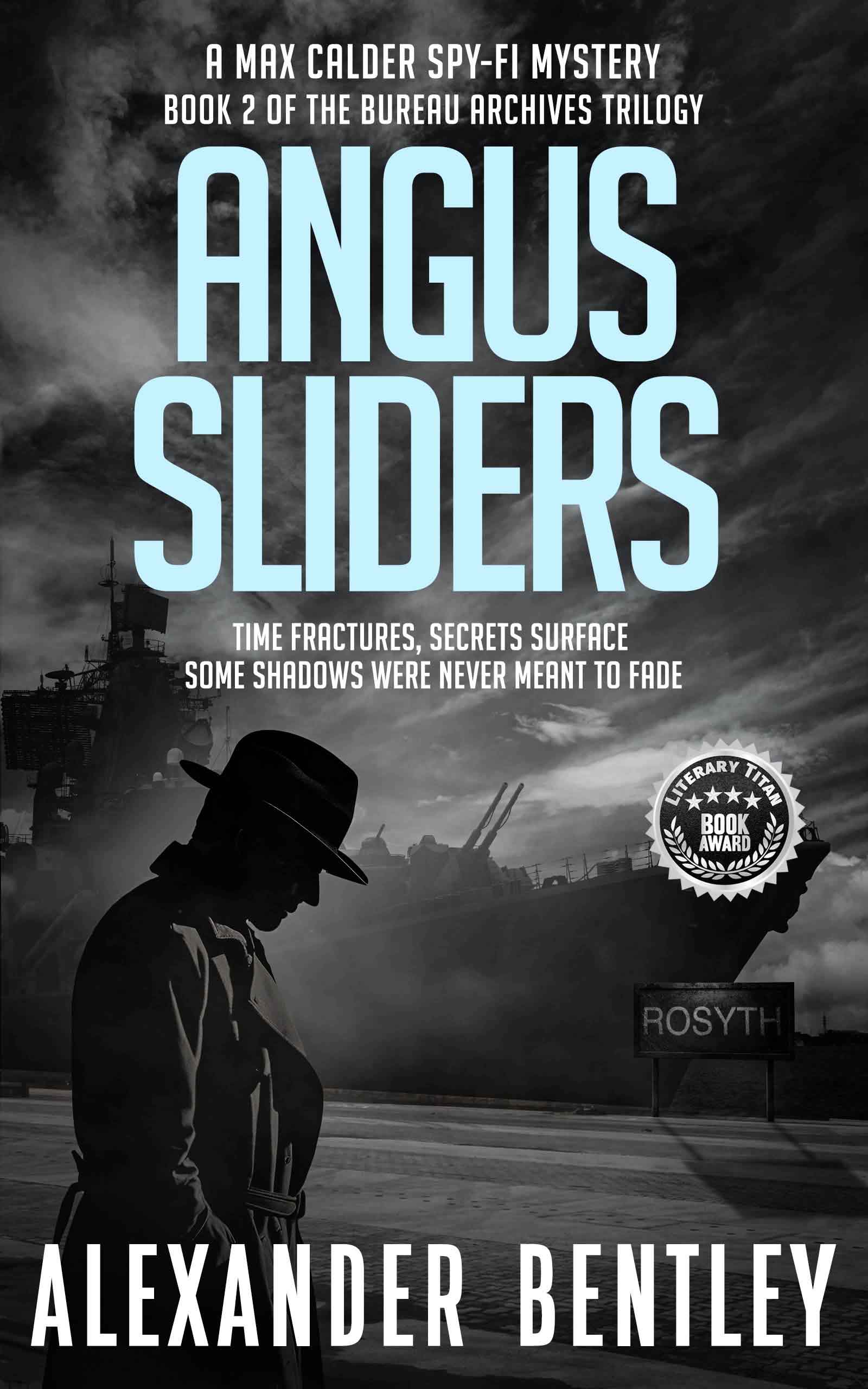
In Lisbon, former British intelligence officer Max Calder intercepts a mysterious transmission suggesting that his former employers are concealing a dangerous secret.
When Bureau operative Alicia Rayes brings evidence of renewed activity surrounding the Mirror, their investigation leads to Scotland's Rosyth Dockyard and a clandestine scientific program.
But British intelligence may be compromised, Soviet operatives are pursuing the same technology, and Calder's fractured memories threaten his judgment.
As rival intelligence services compete to control a machine capable of disturbing time and reality, Calder must confront a terrifying possibility: the past is not finished with him.
In Lisbon, former British intelligence officer Max Calder is attempting to escape the consequences of his previous encounters with the Mirror, an experimental apparatus capable of disturbing time, memory and physical reality. But his recovery is far from complete. Memories disappear without warning, disturbing dreams revisit earlier missions, and he sometimes struggles to recognize people he once trusted.
Then an intercepted British intelligence transmission raises troubling questions about MI6 activity.
When Alicia Rayes, the Bureau operative known as Artemis, arrives with evidence of unexplained events near Scotland's Rosyth Naval Dockyard, Calder realizes that the Mirror may not have been destroyed after all.
The investigation draws them back to Britain, where wartime secrets have become valuable commodities in the developing confrontation between East and West. Hidden research facilities, classified scientific records and suspicious intelligence operations suggest that competing organisations are attempting to recover and reconstruct technology whose consequences remain dangerously unpredictable.
Among the figures moving through this uncertain world is Kim Philby, a senior British intelligence officer whose connections and influence complicate an already delicate investigation.
As Calder and Alicia follow the trail from London into Scotland, they encounter a struggle extending beyond the conventional contest between British and Soviet intelligence. The Mirror's effects challenge the reliability of observation and memory, while the possibility of human duplication raises disturbing questions about identity and personal existence.
For Calder, the investigation is particularly dangerous. His own experiences may hold essential clues, but the closer he comes to understanding them, the less certain he becomes of the past.
Combining historical espionage, intelligence betrayal and speculative quantum science, Angus Sliders takes The Bureau Archives Trilogy into the secret laboratories and divided loyalties of postwar Britain.
The Mirror has survived. The question is who intends to control it—and what they are prepared to sacrifice.
In Lisbon, former British intelligence officer Max Calder is trying to put his clandestine career behind him. His encounters with an extraordinary experimental apparatus known as the Mirror have left him with disturbing gaps in his memory, recurring nightmares and the unsettling possibility that his understanding of his own past cannot be trusted.
Then an intercepted radio transmission draws his attention to suspicious activity within British intelligence.
Calder's uneasy retirement ends when Alicia Rayes, the Bureau operative known as Artemis, arrives with evidence suggesting that the Mirror may have survived its apparent destruction. A photograph taken near Scotland's Rosyth Naval Dockyard raises an even more disturbing question: why does it appear to show another Max Calder?
Their investigation leads them back to Britain, where the wartime scientific program responsible for developing the Mirror has left behind a dangerous legacy.
Rosyth, once the location of highly classified experiments, should have been secured and abandoned. Instead, rumours of missing components, concealed records and unauthorised activity suggest that someone has been recovering the technology. The trail points towards clandestine British intelligence operations and a secret scientific installation in the Scottish Highlands.
For Calder and Alicia, the implications are profound. If the Mirror can be reconstructed, its extraordinary capabilities could become instruments of Cold War espionage.
The apparatus exploits speculative principles of quantum entanglement and superposition, extending them into a fictional technology capable of disturbing temporal continuity and producing alternative manifestations of human existence. Its effects are unpredictable, potentially catastrophic and increasingly difficult to distinguish from ordinary reality.
As their investigation develops, Calder and Alicia encounter an intelligence world dominated by concealed loyalties and institutional rivalries. The historical figure Kim Philby, already an influential British intelligence officer, occupies a particularly sensitive position within this environment. His access to classified information makes the question of who can be trusted increasingly urgent.
Meanwhile, Soviet intelligence is pursuing scientific advantages of its own, determined not to allow Britain or the United States exclusive control of revolutionary technology.
For Calder, however, the danger is more immediate. His missing memories may contain information essential to understanding what happened at Rosyth, while the Mirror's continuing influence threatens his ability to distinguish personal experience from an altered past.
Alicia becomes both his closest operational ally and an important connection to the life he is struggling to remember. Their relationship must withstand the pressures of a mission in which appearances, recollections and even identities can be misleading.
Moving between Lisbon, London, Edinburgh, Rosyth and the Scottish Highlands, Angus Sliders combines Cold War intelligence intrigue with a speculative scientific mystery.
The second novel in The Bureau Archives Trilogy expands the conflict from the pursuit of a dangerous invention to the consequences of intelligence organisations attempting to possess and reproduce it.
In a world where betrayal is an occupational hazard, Max Calder faces an enemy more difficult to identify than a double agent: a technology capable of making him doubt himself.
The Mirror was supposed to be destroyed. But the most dangerous discoveries of the Second World War are proving impossible to bury.
It is 1948, and the uneasy peace that followed the defeat of Nazi Germany is rapidly giving way to a new confrontation. Europe remains divided, Soviet influence is expanding across the East, and Britain's intelligence services are adjusting to a world in which yesterday's allies have become today's potential enemies.
The struggle for political and military advantage is already extending into the laboratories and classified research program inherited from the war. German scientists, experimental weapons and secret intelligence archives have become valuable prizes. Governments are prepared to overlook uncomfortable histories if the knowledge they acquire might provide an advantage over their rivals.
But one scientific discovery presents a threat unlike anything the intelligence services have encountered.
An experimental apparatus known as the Mirror has demonstrated extraordinary and deeply unsettling capabilities. Developed under the supervision of a clandestine organization called the Bureau, the technology appears capable of disturbing the relationship between time, memory and physical reality itself.
The Mirror was supposed to have been destroyed.
For Max Calder, a former British intelligence officer who has already experienced its effects, that should have been the end of the matter.
Instead, it is only the beginning.
Calder is living in Lisbon, a city that retained its importance as an international espionage centre long after the end of the war. Beneath its outward atmosphere of cafés, hotels and diplomatic respectability, intelligence operatives continue to exchange information, cultivate contacts and pursue the unfinished business of the conflict.
Calder wants little to do with any of it.
His previous encounters with the Mirror have left him physically and psychologically unsettled. He suffers from recurring nightmares, inexplicable lapses in memory and disturbing episodes in which the boundaries between recollection and imagination become uncertain. His former life as an intelligence operative is increasingly difficult to reconcile with the fragmented experiences that continue to intrude upon his present.
Then a radio transmission changes everything.
Listening to the shortwave frequencies he once monitored professionally, Calder intercepts a coded message that appears to originate from British intelligence. Its content and manner of transmission raise questions he cannot dismiss. Something is happening within MI6, and the signs suggest that it may be connected to the technology he believed had disappeared.
His suspicions intensify when Alicia Rayes arrives in Lisbon.
Known within the Bureau by the codename Artemis, Alicia is a resourceful and determined intelligence operative who has worked alongside Calder through some of his most dangerous assignments. She understands both his capabilities and the difficulties created by his unreliable memory.
She also brings disturbing intelligence.
Reports of unexplained activity have emerged from Rosyth Naval Dockyard in Scotland, the site of highly classified wartime experiments involving the Mirror. Equipment and scientific records may have disappeared from supposedly secure storage. There are indications of unauthorised investigations and possible involvement by British intelligence personnel.
Most troubling of all is a photograph apparently taken near the dockyard.
It appears to show Max Calder.
For a man already uncertain of his own recollections, the image presents an almost impossible question. Is it evidence of a deception, an intelligence operation designed to manipulate him, or another manifestation of the technology that has already disrupted his life?
Calder and Alicia return to Britain to investigate.
Their journey takes them into a country still recovering from wartime exhaustion. Rationing remains part of everyday life, the Royal Navy is adapting to peacetime requirements, and Britain's global position is being reassessed amid growing American influence and Soviet ambition.
Yet beneath the familiar machinery of government and national defense, secret scientific work continues.
Rosyth provides a particularly compelling setting for the investigation. Situated on the Firth of Forth, the dockyard played a major role in maintaining Britain's wartime naval strength. Its extensive industrial facilities, restricted military areas and history of classified operations make it a plausible location for experiments that could never have been conducted openly.
The Bureau's wartime presence at Rosyth has left unanswered questions. Official records offer only part of the picture, and the consequences of earlier experiments remain imperfectly understood.
As Calder and Alicia investigate, they begin to suspect that components of the Mirror and knowledge of its operation have found their way into other hands.
The trail leads through London's intelligence establishment, the subterranean world of classified storage facilities and the remote landscapes of Scotland, where a secret research programme may be attempting to reproduce technology that its original developers could not fully control.
This brings the protagonists into conflict with powerful institutional interests.
British intelligence is no longer simply an organization Calder once served. It is also a potential obstacle to his investigation. Its officers operate within competing departments, informal networks and carefully protected chains of authority. Information is distributed according to need, and the justification for secrecy is not always distinguishable from the desire to conceal wrongdoing.
Among the historical figures incorporated into the novel is Kim Philby, whose position within British intelligence provides a particularly charged dimension to the story.
Philby is presented within the novel's fictional intelligence narrative against the background of his historical association with Soviet espionage. His presence introduces one of the defining anxieties of the early Cold War: the possibility that the most dangerous adversary is not an enemy operating beyond national borders, but a trusted colleague with access to the most sensitive secrets.
The wider contest also involves Soviet intelligence, whose interest in revolutionary scientific technology reflects the increasingly competitive relationship between Moscow and the Western powers.
If the Mirror can be reconstructed, possession of its capabilities could provide an intelligence advantage far beyond anything offered by conventional cryptography, surveillance or weapons development.
But the technology is not a passive instrument awaiting instructions.
Its effects are difficult to predict, and the people exposed to it may experience consequences that cannot be contained within the usual boundaries of a military experiment.
The scientific foundation of Angus Sliders draws upon speculative extensions of quantum mechanics, particularly entanglement and superposition.
In established physics, these concepts describe phenomena observed at quantum scales. The novel imagines a fictional technology that extends such principles into the human world, where different states of existence might intersect and where alternative manifestations of a person could become more than theoretical possibilities.
The result is a scientific premise that challenges familiar assumptions about identity and continuity.
Can an individual exist in more than one version? If separate manifestations of the same person are connected, what happens when their experiences diverge? And if a person's memories no longer provide a dependable record of events, what remains of the identity built upon them?
These questions are not simply philosophical diversions. They are central to Calder's investigation.
He is an intelligence officer whose profession depends upon accurate observation, reliable memory and the ability to distinguish truth from deliberate deception. Yet the Mirror threatens all three.
His greatest professional strengths are being undermined by the very phenomenon he must investigate.
Alicia provides an essential counterweight. More willing to challenge Calder's assumptions and less inclined to accept his instinctive conclusions, she brings discipline and perspective to their partnership. Their shared history gives their relationship emotional weight, but the uncertainties surrounding Calder's memory create tensions that ordinary trust cannot easily resolve.
As the investigation progresses, their personal connection becomes increasingly important. In a world where identities can be questioned and recollections challenged, the ability to trust another person acquires a significance that goes well beyond professional loyalty.
The Bureau itself adds another dimension to the story.
Operating outside conventional national intelligence structures, the organization was created to confront threats that ordinary governments and security services might be unable to understand or contain. Its resources, scientific knowledge and international reach give it considerable influence, but its secrecy also raises questions about accountability.
The Bureau's interests do not necessarily coincide with those of MI6, the Soviet intelligence services or the individuals conducting the investigation.
Calder and Alicia must therefore navigate a complicated landscape in which apparently friendly institutions may conceal competing objectives, and where official authorization offers no guarantee of safety.
The stakes are considerable.
A reconstructed Mirror could transform the balance of power between East and West, creating opportunities for espionage and manipulation that no existing security arrangements could adequately address. Its uncontrolled effects could endanger individuals, destabilise intelligence operations and undermine the assumptions upon which governments make decisions.
The threat is not limited to who possesses the technology.
It is whether any organization possesses the knowledge, restraint or authority necessary to control it.
This is what distinguishes Angus Sliders from the other novels in The Bureau Archives Trilogy.
Furniture Sliders, the opening book, introduces the Mirror through the mystery of Max Calder's missing memories and his pursuit of a scientist associated with its development. Its principal dramatic force comes from discovery: the gradual recognition that a secret wartime program has created something capable of challenging accepted reality.
Angus Sliders takes that premise into a more overtly political and institutional arena.
The question is no longer simply what the Mirror can do, but what happens when established intelligence services attempt to recover, reproduce and exploit its capabilities.
The novel brings the scientific mystery into direct contact with the real history of British intelligence, Soviet penetration and the strategic anxieties of the early Cold War. It explores the danger of treating an extraordinary discovery as another classified asset, subject to the same calculations of national interest and institutional advantage as any conventional weapon.
It also deepens the personal consequences for Calder.
His fractured memories are no longer merely evidence of earlier encounters with the Mirror. They become an active complication in an investigation where the distinction between the authentic and the artificial may determine whether he survives.
The Scottish setting gives the novel its own atmosphere and identity. From Edinburgh and the industrial installations of Rosyth to remote Highland roads and concealed research facilities, the landscape combines familiar postwar Britain with a hidden world of experimental science and clandestine operations.
The contrast is deliberate: ordinary institutions and recognizable historical places conceal activities whose consequences could extend far beyond national boundaries.
Where the first book introduces an extraordinary threat, Angus Sliders examines the dangers of institutional ambition, divided loyalties and scientific reconstruction.
It is a story about intelligence betrayal, the persistence of wartime secrets and the difficulty of controlling discoveries whose consequences exceed the intentions of their creators.
Above all, it is the story of a man trying to establish the truth in a world where his own memories may be the least reliable evidence available.
The war may be over, but its most dangerous experiment has survived. And this time, the enemy may be working inside the very organizations determined to control it.
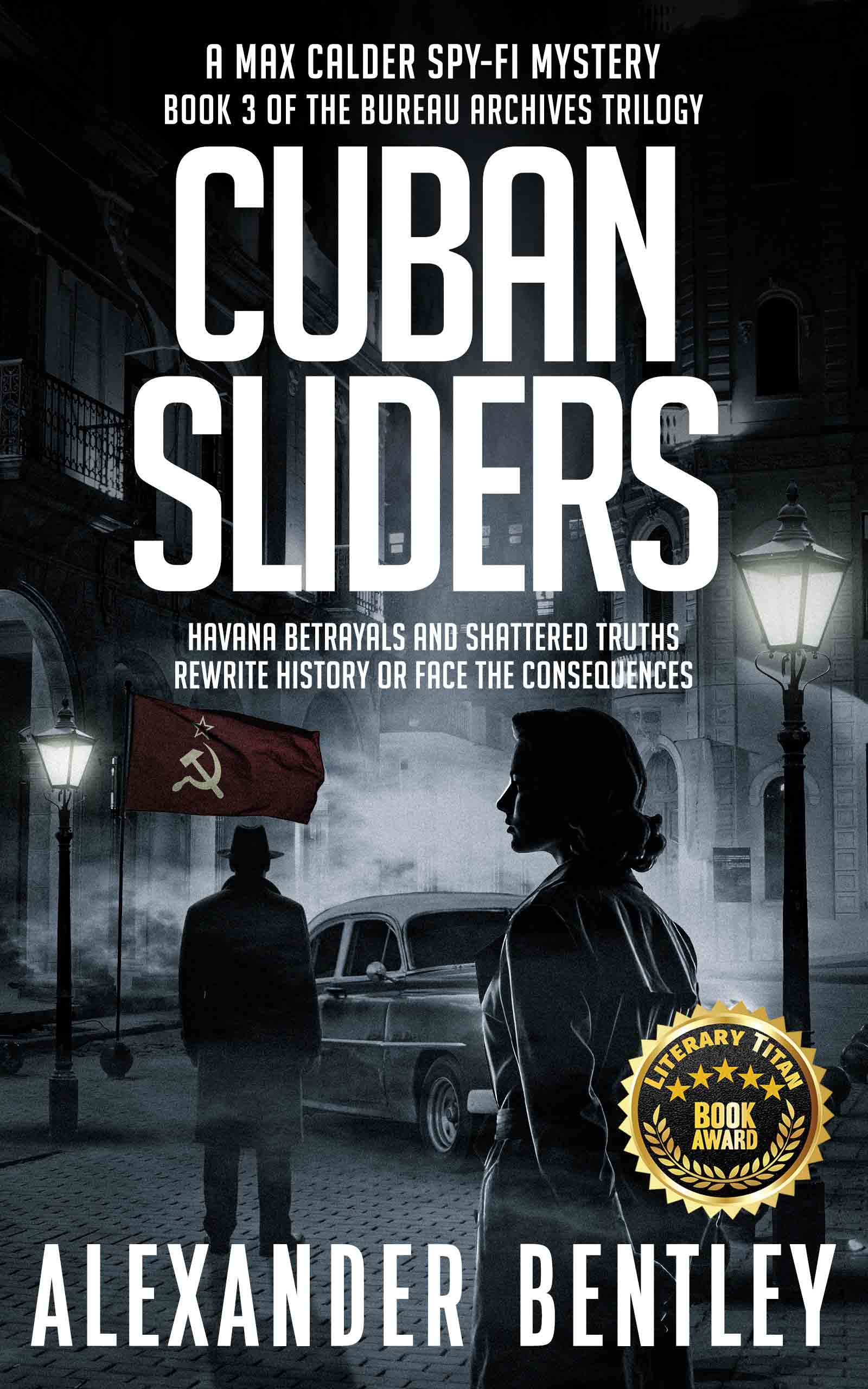
When a Soviet scientist dies under impossible circumstances, former MI6 officer Max Calder and Bureau operative Alicia Rayes investigate evidence that the Mirror—a device capable of disturbing time, space and identity—has been rebuilt in Cuba.
Beneath a rum distillery, Soviet scientists are developing technology that could change the balance of global power. But a more insidious capability is emerging: the suppression of human choice.
With the CIA, MI6 and Soviet intelligence pursuing competing objectives, Calder must confront a threat that could make resistance itself impossible.
As the Cold War begins, Calder must uncover the truth before a dangerous scientific discovery falls into Soviet hands.
When Soviet physicist Sergei Markov dies under extraordinary circumstances, American intelligence discovers disturbing evidence of temporal instability. The symptoms resemble those associated with the Mirror, an experimental apparatus developed during the Second World War and believed to have been destroyed.
For former MI6 officer Max Calder, the discovery brings an unwelcome return to a technology that has already shattered his memories and undermined his understanding of reality.
Reunited with Bureau operative Alicia Rayes, Calder is sent to investigate reports that Soviet scientists have reconstructed the Mirror beneath a rum distillery near Havana. Their mission takes them into a world of clandestine laboratories, compromised intelligence networks and competing national ambitions.
The CIA, represented by the formidable James Jesus Angleton, has its own interest in the technology. British intelligence remains entangled in the affair, while the influence of Kim Philby raises troubling questions about divided loyalties and the security of Western secrets.
But the scientific threat is evolving.
The Mirror's ability to disrupt time, space and human identity is only part of its potential. A new application, known as Decision Locking, appears capable of narrowing human judgment until disagreement disappears and a single course of action seems inevitable.
In a world increasingly divided by ideology, such a capability could transform international politics without firing a shot.
As Calder and Alicia pursue the investigation through Havana and the wider Caribbean, they must confront Soviet operatives, competing Western intelligence interests and a technology whose effects are becoming increasingly unpredictable.
The concluding novel in The Bureau Archives Trilogy, Cuban Sliders combines historical espionage, speculative quantum science and political intrigue in a thriller about the ultimate instrument of control.
What happens when the greatest threat to freedom is the loss of the ability to disagree?
In Havana, where American wealth, political corruption, organised crime and international espionage coexist beneath the tropical glamour of Cuba's capital, a Soviet scientist dies in circumstances that defy medical explanation.
Dr Sergei Markov appears to have aged decades in a matter of moments. His death is accompanied by unusual electrical disturbances and evidence of a phenomenon associated with a secret wartime scientific program.
The Mirror has returned.
For former British intelligence officer Max Calder, the news reopens a chapter of his life he has struggled to escape. His earlier encounters with the experimental apparatus have left him with fractured memories, disturbing visions and an increasingly uncertain understanding of his own identity.
When Bureau operative Alicia Rayes is recalled to investigate the incident, the two are drawn into a mission that reaches from London to Cuba and across the Caribbean.
Intelligence reports suggest that Soviet scientists have reconstructed the Mirror in a heavily guarded installation concealed beneath a rum distillery near Havana. The new apparatus appears more advanced than its predecessors, with capabilities that extend beyond the temporal and geographical disturbances previously associated with the technology.
The Bureau wants to prevent another scientific catastrophe. Soviet intelligence is determined to protect its investment. The CIA, represented by James Angleton, recognizes an opportunity to acquire a potentially decisive strategic advantage.
Meanwhile, British intelligence remains vulnerable to divided loyalties, with Kim Philby's position raising uncomfortable questions about the security of Western scientific secrets.
Calder and Alicia must operate within this complicated intelligence environment, where cooperation is provisional, official assurances are unreliable and even apparent allies may be pursuing incompatible objectives.
But the most alarming development is scientific rather than military.
The Mirror's speculative application of quantum entanglement and superposition has produced a new phenomenon: Decision Locking.
Instead of merely disrupting time, location or identity, the technology may be capable of influencing human judgment by reducing the range of alternatives people perceive as possible. Disagreement can disappear without intimidation. Resistance can fail to develop. Individuals may become convinced that decisions imposed upon them were entirely their own.
For intelligence agencies and governments, the implications are extraordinary.
For Calder, they are terrifying.
Already struggling to distinguish authentic memories from the effects of earlier experiments, he faces a technology that could compromise not only what people remember, but what they choose.
Against the backdrop of Havana's political instability and the developing confrontation between East and West, Calder and Alicia pursue a dangerous investigation involving clandestine research, rival operatives and scientific experiments whose consequences threaten to escape their creators' control.
Cuban Sliders, the concluding novel in The Bureau Archives Trilogy, brings the Mirror's wartime origins into direct conflict with the political ambitions of the early Cold War.
The ultimate weapon may not destroy cities or defeat armies. It may simply make opposition impossible.
The war for control of the Mirror is approaching its most dangerous stage. But the greatest threat is no longer what the technology can do to time and space. It is what it can do to the human mind.
It is 1951, and the world is entering a new and increasingly dangerous phase of the Cold War.
The Second World War ended only six years earlier, yet the alliance that defeated Nazi Germany has disintegrated. The Soviet Union and the United States are competing for political influence, military superiority and control of scientific discoveries that might transform the balance of power. The Soviet atomic bomb has ended America's nuclear monopoly, the Korean War has demonstrated the willingness of both sides to confront one another through proxy conflicts, and intelligence agencies are becoming central instruments of national strategy.
Against this historical background, Cuba occupies a particularly sensitive position.
Havana is a city of extraordinary contrasts. American tourists fill its luxury hotels, casinos and nightclubs. Music pours from the bars along its crowded streets, while wealthy businessmen, political intermediaries and organized crime figures conduct business behind the polished façades of the capital's entertainment districts.
Yet beneath the glamour lies a country struggling with political corruption, competing interests and the continuing influence of former president Fulgencio Batista.
The city is also an ideal environment for clandestine activity.
Foreign intelligence officers operate through diplomatic establishments, shipping companies and commercial contacts. Soviet couriers move through the port, American intelligence maintains an extensive regional presence, and the boundaries between legitimate business, political influence and espionage are frequently difficult to distinguish.
It is here that an extraordinary death attracts the attention of the CIA.
A Soviet physicist, Dr Sergei Markov, has died under circumstances that cannot be explained by conventional medicine. His body exhibits signs of rapid biological ageing, while reports of electrical disturbances and unexplained physical effects suggest that something far more unusual has occurred.
For CIA intelligence officer James Jesus Angleton, the details are disturbingly familiar.
The symptoms resemble those associated with the Mirror, a clandestine experimental apparatus developed during the Second World War. The device was believed to have been destroyed following a series of increasingly dangerous incidents involving the manipulation of time, physical location and human identity.
Its apparent reappearance in Cuba presents an immediate intelligence emergency.
If Soviet scientists have reconstructed the technology, Moscow may possess an advantage that neither conventional weapons nor established intelligence methods can adequately counter.
For Max Calder, the news is profoundly personal.
A former MI6 officer subsequently recruited into the secretive Bureau, Calder has spent years investigating the Mirror and confronting the consequences of its development. His experiences have taken him through wartime intelligence operations, classified scientific installations and dangerous encounters with individuals determined to exploit the apparatus.
But the technology has also exacted a personal price.
Calder's memories remain unreliable. Certain periods of his life are missing or fragmented, while recollections of previous assignments sometimes contradict what he believes to be true. He has experienced disturbances that challenge his understanding of identity, and he cannot always be certain whether a memory belongs to the past he lived or to another possible version of events.
He has learned that the Mirror is not merely an experimental machine. Its effects can reach into the lives of those exposed to it, leaving consequences that persist long after the equipment has been switched off.
Now he must confront the possibility that the technology has returned in a more advanced and dangerous form.
Alicia Rayes, the Bureau operative known by the codename Artemis, is also recalled to the investigation.
Experienced, resourceful and accustomed to working under conditions of extreme uncertainty, Alicia has become Calder's closest operational partner. Their relationship has developed through shared assignments, professional disagreements and experiences that neither can entirely explain.
She understands the dangers of the Mirror, but she also recognises the practical difficulties created by Calder's damaged memory. His instincts and intelligence experience remain invaluable, yet his recollections cannot always be accepted without independent verification.
Their partnership provides an essential human element to a story in which personal identity and trust are increasingly vulnerable.
The Bureau assigns them to investigate evidence that Soviet scientists have established a new Mirror installation in Cuba.
The intelligence points towards a rum distillery near Havana, where ordinary commercial operations may conceal a sophisticated scientific facility.
The location offers an effective disguise. Cuba's sugar and rum industries provide a legitimate explanation for industrial equipment, imported machinery, electrical installations and the movement of technical personnel. Shipping activity creates opportunities to transport sensitive components without immediately attracting attention.
Behind this commercial façade, however, the Soviets appear to be conducting experiments whose consequences could extend far beyond the Caribbean.
The apparatus under development represents a new stage in the Mirror's evolution.
Earlier versions demonstrated the ability to produce extraordinary disturbances in time and space, allowing people and objects to experience displacements that defied conventional physical explanation. These phenomena created opportunities for intelligence operations but also exposed the instability and unpredictability of the underlying science.
The new installation appears capable of more sophisticated effects.
Its scientific premise draws upon speculative extensions of quantum mechanics, particularly entanglement and superposition.
Quantum entanglement describes correlations between quantum systems, while superposition concerns the mathematical description of multiple possible states before measurement. Cuban Sliders imagines a fictional technology that extends these concepts far beyond their established scientific applications.
Within the world of the novel, the Mirror can interfere with the relationship between alternative states of existence, temporal continuity and human cognition.
This gives rise to a disturbing possibility.
What if the technology could do more than displace individuals through time or space? What if it could influence the way people perceive alternatives and arrive at decisions?
The emerging phenomenon is known as Decision Locking.
Unlike conventional mind control, Decision Locking does not necessarily require a person to obey an explicit instruction. Instead, it appears to reduce the range of choices that the individual recognises as reasonable or possible.
Uncertainty diminishes. Opposition weakens. Conflicting judgments converge.
A person affected by the technology may believe that a particular decision is entirely voluntary, even when the process through which that decision was reached has been manipulated.
For governments and intelligence organizations, the potential applications are almost limitless.
Political disagreements could be resolved without negotiation. Institutional resistance might disappear without arrests or intimidation. Military and diplomatic decisions could be influenced without the visible deployment of force.
The technology threatens to transform the nature of political power.
Where nuclear weapons offer the ability to destroy, Decision Locking offers the possibility of control without destruction.
This is the central scientific and moral conflict of Cuban Sliders.
The Mirror's earlier capabilities challenged the physical boundaries of reality. Its emerging applications threaten the freedom of individuals and institutions to make independent choices.
The implications are particularly alarming in the geopolitical climate of 1951.
The Soviet Union is determined to prevent the United States from securing another decisive technological advantage. American intelligence is equally unwilling to allow Moscow exclusive control of a discovery that might influence military planning, political leadership and international alliances.
The British intelligence establishment, still recovering from the demands of the Second World War and adapting to its changing relationship with Washington, occupies a complicated position between cooperation and independent national interests.
The involvement of Kim Philby adds another layer of tension.
A prominent figure within British intelligence, Philby operates in a world of sensitive information exchanges and close relationships between British and American officers. His historical association with Soviet espionage makes him a particularly significant presence in a fictional narrative concerned with compromised secrets and the vulnerability of intelligence alliances.
James Jesus Angleton provides a contrasting perspective.
As an influential CIA officer with experience in wartime intelligence and close professional connections to British intelligence, Angleton recognizes both the strategic possibilities of the Mirror and the danger of allowing sensitive scientific knowledge to pass into hostile hands.
His interests do not necessarily coincide with those of the Bureau.
The Bureau's purpose is to identify, contain and prevent the misuse of phenomena that conventional intelligence organizations cannot adequately manage. Its leadership understands the destructive potential of the Mirror and the dangers of attempting to exploit technology whose full capabilities remain unknown.
The CIA, however, must consider the possibility that refusing to develop the technology could leave the United States vulnerable to an adversary willing to use it.
These competing priorities create an unstable environment for Calder and Alicia.
They must work with intelligence organisations whose assistance is necessary but whose objectives may be incompatible with their own mission.
The investigation also introduces operatives whose loyalties are difficult to establish, including Lucy Howard, a capable and enigmatic intelligence officer whose presence adds further uncertainty to an already complicated operation.
No organization possesses a complete understanding of the technology. No participant can be certain that the intelligence received from another service is accurate. And no government can easily ignore the potential strategic advantage represented by the Mirror.
As the investigation develops, the action moves beyond Havana into the wider Caribbean.
The region provides an atmospheric contrast to the heavily guarded scientific installations and intelligence offices at the center of the story.
The islands of the Grenadines, including Mustique, Bequia and St Vincent, offer a world of small harbors, coastal settlements, inter-island shipping routes and isolated communities. In 1951, these islands remain far removed from the luxury tourism and international celebrity culture that would later transform parts of the region.
Their relative isolation also makes them suitable locations for clandestine movements and intelligence operations.
The geographical expansion of the story gives Cuban Sliders a broader operational scope than its predecessors. The protagonists must navigate unfamiliar territory, limited communications, uncertain transport and the practical difficulties of conducting intelligence work far from established support networks.
Yet the dangers are not confined to armed opponents or hostile surveillance.
The Mirror itself remains an unpredictable presence.
Its effects challenge the ordinary assumptions upon which intelligence operations depend. Time may not behave consistently. Physical location cannot always be treated as fixed. Identity and memory may be less reliable than official records suggest.
For Calder, these uncertainties are especially dangerous.
His previous exposure to the Mirror makes him unusually sensitive to the possibility that events are not unfolding as they appear. At the same time, the damage to his memory creates a weakness that an adversary might exploit.
He must determine which of his recollections can be trusted while investigating a scientific program capable of undermining the process of human judgment itself.
Alicia faces a different challenge.
She must maintain operational discipline while working alongside a partner whose experiences give him essential insight but whose perceptions may also be compromised. Their relationship depends upon a degree of trust that becomes increasingly difficult to sustain when even apparently objective evidence can be questioned.
The personal stakes are therefore inseparable from the wider intelligence conflict.
The struggle over the Mirror is not simply a contest between governments. It is also a confrontation with the possibility that human beings may lose the ability to distinguish authentic experience from manufactured certainty.
This is what makes Cuban Sliders distinct within The Bureau Archives Trilogy.
In Furniture Sliders, the opening novel, the Mirror emerges from the secret scientific programs of the Second World War. The principal mystery concerns the nature of the apparatus, the individuals responsible for its development and the consequences of Calder's earliest encounters with it.
In Angus Sliders, the conflict moves into the postwar intelligence establishment. The investigation centers on attempts to recover and reconstruct the technology, particularly through British intelligence networks and clandestine installations in Scotland. Institutional secrecy, Soviet penetration and divided loyalties become increasingly important.
Cuban Sliders takes the underlying premise to its logical and most politically dangerous extension.
The question is no longer simply whether the Mirror exists or who can rebuild it.
It is whether the technology can be transformed into a means of controlling human behavior on a scale that could alter the course of international affairs.
The novel combines the atmospheric espionage of the early Cold War with the glamour and instability of pre-revolutionary Cuba. It incorporates historical figures and political tensions into a fictional struggle involving scientific research, intelligence betrayal and the emerging competition for technological supremacy.
Its setting also provides a distinctive dramatic identity.
The streets and casinos of Havana, the industrial secrecy of the Cuban rum trade, the political influence of Batista, the strategic interests of Washington and Moscow, and the remote islands of the Caribbean form a varied and increasingly dangerous landscape.
Against this background, Calder and Alicia must confront adversaries whose objectives are clear even when their identities and loyalties are not.
The Soviets want to preserve their scientific advantage. The Americans want to prevent that advantage from becoming decisive. British intelligence is caught between cooperation, secrecy and the consequences of compromised information. The Bureau is determined to prevent a technology it considers profoundly dangerous from becoming another instrument of state power.
Each organization believes its position can be justified.
That is precisely what makes the conflict so difficult.
The Mirror has created a situation in which every intelligence service fears what its rivals might do with the technology, yet none can be entirely trusted to resist the temptation to exploit it.
For Max Calder, the ultimate question is more fundamental than national security.
If technology can determine which choices appear possible, can an individual still be said to possess free will?
And if entire institutions can be brought into agreement without recognizing that their judgment has been manipulated, what becomes of democracy, diplomacy and the political freedoms governments claim to defend?
Cuban Sliders brings the scientific mysteries, personal conflicts and intelligence rivalries of The Bureau Archives Trilogy together in a Cold War thriller that expands the meaning of technological warfare.
The threat is no longer confined to laboratories, secret installations or the individuals exposed to experimental machinery.
It has become a question about the future of human decision-making.
The world's most powerful weapon may not be one that forces people to surrender. It may be one that convinces them there was never another choice.

When an unexplained phenomenon disrupts operations at Edwards Air Force Base, British intelligence officers Giles Harrington and Lucy Howard investigate evidence of a clandestine scientific program.
Their inquiries lead to Edward Teller's laboratory at Livermore and a technology known as Decision Locking, capable of eliminating disagreement while leaving its subjects convinced they have chosen freely.
As the CIA, Soviet intelligence and rogue operatives compete for control, Giles and Lucy uncover a threat extending far beyond military superiority.
The future of the Cold War may depend on who controls humanity's ability to choose.
When an American test pilot encounters an inexplicable phenomenon at Edwards Air Force Base, British intelligence officers Giles Harrington and Lucy Howard are drawn into an investigation that neither military authorities nor the CIA can adequately explain.
Their search leads to Livermore, California, where physicist Edward Teller is involved in research with implications far beyond nuclear weapons.
The technology is called Decision Locking.
Rather than controlling minds through conventional coercion, it appears capable of narrowing human judgment until disagreement disappears. Individuals reach decisions with unnatural certainty, unaware that the alternatives they might have considered have been suppressed.
For intelligence agencies, the possibilities are extraordinary. For democratic governments, the consequences could be catastrophic.
Giles, an experienced MI6 officer with an analytical approach to intelligence work, is determined to establish what the evidence proves. Lucy, a resourceful counter-espionage operative, is equally concerned with the people concealing it. Their contrasting instincts become essential as the investigation exposes competing ambitions within American intelligence and the growing interest of Soviet operatives.
Among those involved are CIA counterintelligence officer James Jesus Angleton and Grant Baldwin, an ambitious American intelligence official convinced that the technology offers a strategic advantage too important to ignore.
As the trail extends from California to Camp Hero on Long Island, through clandestine shipping networks in Central America and towards the Soviet Arctic, Giles and Lucy discover that Decision Locking is no longer merely a laboratory experiment.
The first novel in The Consensus Files, The Teller Threshold combines historical espionage, speculative quantum science and international intrigue in a story about the ultimate instrument of political control.
What happens when people can be made to agree without ever knowing their freedom to disagree has been taken away?
But the most dangerous discovery may have nothing to do with the atomic bomb.
At Edwards Air Force Base in California, an American test pilot encounters an inexplicable shimmering phenomenon during a military operation. Instruments record anomalies that cannot be reconciled with conventional equipment failure, and official explanations fail to account for the testimony of those involved.
British intelligence officer Giles Harrington is assigned to investigate. His analytical instincts and experience in clandestine operations make him particularly suited to examining evidence that others would prefer to dismiss.
He is joined by Lucy Howard, a capable and resourceful MI6 counter-espionage operative whose understanding of intelligence networks complements his methodical approach.
Their investigation leads to Livermore, where physicist Edward Teller is involved in a classified scientific programme with implications extending far beyond nuclear research.
At its center is Decision Locking, an experimental technology capable of influencing the process through which human beings make choices.
Unlike conventional psychological manipulation, Decision Locking does not implant thoughts or issue commands. Instead, it appears to suppress competing alternatives until individuals or groups arrive at a single conclusion with extraordinary certainty.
Those affected remain convinced that their decisions are entirely voluntary.
For governments, the strategic possibilities are almost unimaginable. Political opposition could disappear without intimidation. Military commanders might reach predetermined conclusions without recognizing external interference. Diplomatic negotiations could produce agreement without genuine consent.
For Giles and Lucy, the implications are terrifying.
The technology has attracted the attention of competing American intelligence interests, including CIA counterintelligence officer James Angleton and Grant Baldwin, an ambitious official who believes the discovery could transform the conduct of the Cold War.
Edward Teller understands the scientific dangers, but controlling the political ambitions surrounding the research proves increasingly difficult.
Meanwhile, Soviet intelligence is pursuing its own objectives. Reports of experimental installations, unusual behavior and clandestine movements suggest that the technology's development is no longer confined to a single laboratory or nation.
As the investigation expands from California to Long Island, Central America and the frozen approaches to the Soviet Arctic, Giles and Lucy encounter compromised intelligence channels, covert shipments, dangerous operatives and conflicting national interests.
The Office of Decision Integrity, a secret organization established to investigate threats to independent human judgment, faces a challenge that conventional espionage methods cannot resolve.
How can an intelligence service identify manipulation when those affected sincerely believe they have acted freely?
And how can governments be trusted to contain a technology that offers them unprecedented political power?
Set against the authentic geopolitical tensions of 1955, The Teller Threshold introduces the scientific mystery, intelligence rivalries and moral conflicts at the heart of The Consensus Files.
The greatest threat to freedom may not be a weapon that forces humanity to surrender, but one that makes surrender appear to be a choice.
In the Cold War, certainty is becoming a weapon. And the most dangerous technology ever developed may be one that eliminates the need to persuade.
It is 1955, and the world is living under the growing threat of nuclear annihilation.
The Second World War ended only a decade earlier, but the alliance that defeated Nazi Germany has collapsed into a confrontation between two competing political systems. The United States and the Soviet Union are developing increasingly powerful nuclear weapons, military planners are preparing for conflicts that might destroy entire nations, and intelligence agencies are searching for advantages that could determine the outcome of the Cold War.
The hydrogen bomb has transformed strategic thinking. The possibility of nuclear destruction influences diplomacy, military planning and the decisions made in government offices on both sides of the Iron Curtain.
Yet behind the familiar competition for nuclear superiority, another scientific development is emerging.
Its potential consequences may be even more profound.
At Edwards Air Force Base in California, an American test pilot encounters an extraordinary phenomenon during an operation over the desert. A strange shimmering disturbance appears where nothing should exist. Instruments behave unpredictably, and the pilot's account raises questions that conventional explanations cannot resolve.
The incident attracts the attention of American military authorities and intelligence officials, but the available evidence is contradictory. Some reports suggest an unusual atmospheric or electrical disturbance. Others point towards experimental technology that should not exist.
The official response is cautious, restrictive and increasingly difficult to justify.
In London, British intelligence officer Giles Harrington is drawn into the investigation.
Educated at Winchester and Oxford, Giles has developed a reputation for careful analysis and an unwillingness to accept explanations that do not account for the evidence. His wartime intelligence experience in Cyprus and subsequent service with MI6 have taught him that the most important information is often found in the inconsistencies of an apparently convincing official account.
He is not easily impressed by authority, particularly when that authority is being used to conceal uncertainty.
For Giles, the Edwards incident presents an intelligence problem unlike anything he has previously encountered.
The witnesses appear credible. The physical evidence is difficult to dismiss. Yet the explanations offered by the American authorities leave important questions unanswered.
He is joined by Lucy Howard, an accomplished MI6 operative with experience in Russian counter-espionage and intelligence liaison.
Lucy approaches the investigation differently.
Where Giles concentrates on reconstructing events and testing the reliability of evidence, Lucy is particularly skilled at identifying the people who control information, the relationships that influence their behaviour and the vulnerabilities hidden within apparently secure organisations.
Confident, resourceful and occasionally impatient with procedural restrictions, she is comfortable operating in circumstances where formal authority provides little protection.
Their contrasting personalities create an uneasy but increasingly effective partnership.
Giles wants to establish precisely what happened. Lucy wants to know who is concealing the truth, and why.
Together, they travel to California, where the Edwards investigation leads them towards a classified scientific programme at Livermore.
The laboratory is closely associated with Edward Teller, one of the most influential and controversial physicists of the nuclear age.
Teller's historical role in the development of thermonuclear weapons makes him an important figure in the scientific and political environment of the novel. His involvement introduces the tensions between scientific discovery, national security and the responsibilities of those whose research can be adapted for military purposes.
But the work that concerns Giles and Lucy is not simply another advance in nuclear weapons.
It involves a technology known as Decision Locking.
The underlying research has its origins in an extraordinary experimental apparatus developed during the Second World War, known as the Mirror.
Earlier investigations revealed that the Mirror could produce disturbances involving time, physical location and human identity. Its effects challenged conventional understanding of reality and created opportunities that intelligence organisations were quick to recognise.
The Mirror's development also demonstrated the dangers of attempting to control scientific phenomena that were not fully understood.
Decision Locking represents a different application of the same speculative scientific principles.
Instead of altering where a person exists or how that person experiences time, the technology appears capable of influencing the process through which decisions are made.
The distinction is fundamental.
Conventional coercion depends upon threats, intimidation, rewards or the direct application of force. Psychological manipulation seeks to change beliefs through persuasion, deception or conditioning.
Decision Locking operates differently.
Within the fictional scientific framework of the novel, the technology interferes with the range of alternatives that individuals perceive as available when making a decision.
Competing judgments lose their force. Objections become less compelling. Uncertainty diminishes.
A person may arrive at a conclusion with complete confidence, unaware that the alternatives which might have led to a different outcome have effectively been suppressed.
When applied to groups, the effect can be even more disturbing.
Disagreement disappears. Meetings reach conclusions with unnatural speed. Participants who might ordinarily hold conflicting opinions arrive at the same position without recognising that anything unusual has occurred.
The resulting agreement appears entirely genuine.
Those involved believe they have exercised independent judgment.
This is what makes Decision Locking so dangerous.
It does not necessarily produce the outward signs associated with coercion. There may be no threats, no visible violence and no obvious evidence of manipulation.
The people affected may sincerely defend decisions that were never entirely their own.
For Giles, the implications extend far beyond the laboratory.
If a technology can interfere with the process of human judgment, it could potentially influence the decisions of military commanders, intelligence officers, diplomats and political leaders.
A government might believe it had freely adopted a particular policy when the range of choices available to its ministers had already been restricted.
An intelligence officer might disclose sensitive information without recognising that the decision had been influenced.
A diplomatic negotiation might produce apparent agreement between opposing governments without either side understanding the extent to which its judgment had been compromised.
The technology threatens the assumptions upon which intelligence analysis, democratic government and international diplomacy depend.
The scientific premise draws upon speculative extensions of quantum mechanics, particularly the relationship between multiple possible states and the processes through which outcomes become established.
In established physics, quantum superposition and entanglement describe phenomena at the quantum level. The Teller Threshold imagines a fictional extension of these concepts into human cognition and collective decision-making.
The result is a form of technological influence that challenges the meaning of consent.
For intelligence agencies operating in the geopolitical climate of 1955, the potential applications are extraordinary.
The United States and Soviet Union are already engaged in an expensive and increasingly dangerous competition for military superiority. Both governments understand that scientific breakthroughs can alter strategic calculations.
But nuclear weapons are ultimately instruments of destruction and deterrence.
Decision Locking offers something different.
It suggests the possibility of influencing an adversary's decisions before a confrontation becomes necessary.
A government possessing such technology might not need to defeat an opponent militarily if it could influence the opponent's judgment about whether resistance was necessary.
This possibility attracts the attention of powerful figures within American intelligence.
James Angleton, the CIA officer whose counterintelligence responsibilities place him at the centre of the struggle against Soviet penetration, recognises the implications for espionage.
Traditional counterintelligence depends upon establishing motives, identifying suspicious behaviour and distinguishing genuine loyalty from deception.
Decision Locking threatens to undermine those methods.
If individuals can be influenced without recognising the interference, an intelligence officer might act against national interests while remaining entirely convinced of his own loyalty.
The familiar distinctions between betrayal, coercion and voluntary action become dangerously uncertain.
Another important figure is Grant Baldwin, an American intelligence official associated with the classified scientific programme.
Baldwin represents a different response to the discovery.
He sees Decision Locking not primarily as a scientific danger, but as a strategic opportunity.
In his view, the Cold War cannot be won through military superiority alone. Nuclear weapons may deter an adversary from launching an attack, but they cannot guarantee that political leaders, military commanders or intelligence officials will make the decisions Washington considers necessary.
A technology capable of influencing those decisions could provide a decisive advantage.
Baldwin's ambitions bring him into conflict with the scientists and intelligence officers who believe that the technology's use must be strictly controlled.
For Edward Teller, the problem is both scientific and ethical.
Research into Decision Locking offers insights into phenomena that conventional science cannot adequately explain. Yet the possibility of manipulating human judgment raises questions that cannot be resolved through laboratory measurements alone.
The ability to demonstrate a scientific effect does not establish that its use is legitimate.
Nor does technical control necessarily provide political restraint.
As Giles and Lucy investigate the Livermore program, they discover that the interests surrounding Decision Locking are far from unified.
American scientists, intelligence officers and government officials approach the technology from different perspectives. Some see an opportunity to understand an extraordinary phenomenon. Others recognise its potential as a weapon. Still others fear that the discovery could destabilise the very political institutions it is intended to protect.
The British government and its intelligence services have their own concerns.
Cooperation with the United States is essential to Western security, but the development of technology capable of influencing decisions raises difficult questions about the independence of allied governments.
If one country possesses the means to influence another country's judgment, the distinction between cooperation and control becomes dangerously uncertain.
The Office of Decision Integrity, known as the ODI, occupies a particularly sensitive position.
Established in the aftermath of earlier investigations into the Mirror, the ODI is a secret organization concerned with identifying, monitoring and preventing the misuse of technology capable of interfering with independent human decision-making.
Its existence reflects the recognition that conventional intelligence agencies may be poorly equipped to investigate phenomena whose effects cannot be understood through ordinary scientific or operational methods.
The ODI must also confront a difficult institutional problem.
It depends upon cooperation with intelligence organisations whose governments may have compelling reasons to acquire the very technology the Office seeks to contain.
The resulting tension places Giles and Lucy in a complicated position.
They require access to American scientific facilities and intelligence records, but they cannot assume that every official involved shares their objectives.
Their investigation becomes an increasingly difficult exercise in determining which information is reliable, which individuals can be trusted and whether the apparent agreement of senior officials represents genuine judgment.
Meanwhile, evidence suggests that Soviet intelligence has been pursuing related scientific research.
The Soviet Union's interest is unsurprising.
Moscow cannot afford to allow Washington exclusive possession of technology that might influence political or military decisions. The possibility of an American capability capable of interfering with Soviet leadership calculations would represent an intolerable strategic vulnerability.
For Soviet intelligence, the discovery presents both an opportunity and a threat.
The competition is therefore not simply between scientists working in rival laboratories.
It involves intelligence networks, covert transportation routes, classified installations and competing political authorities.
As Giles and Lucy follow the evidence, the investigation expands beyond California.
Camp Hero, the former military installation on Long Island, provides another connection between scientific experimentation, military communications and intelligence interests.
Its remote location and restricted facilities reflect the wider Cold War practice of placing sensitive projects within installations whose official purposes reveal little about their classified activities.
The involvement of American intelligence personnel, including specialists associated with behavioural research, introduces further questions about the relationship between experimental science and clandestine operations.
The investigation also reveals the importance of a portable form of the technology.
Unlike a fixed installation requiring extensive scientific equipment, a compact Decision Locking apparatus could potentially be moved between locations and deployed in circumstances where its presence would be difficult to detect.
Within the novel, the portable equipment is concealed in an oxblood attaché case containing an arrangement of copper filaments, controls and a distinctive black core.
Its apparently ordinary exterior contrasts with the extraordinary capability it represents.
The possibility of portable Decision Locking changes the nature of the threat.
A fixed scientific installation can be identified, monitored and subjected to diplomatic or military pressure.
A portable device introduces a far more difficult intelligence problem.
It could be transported through commercial networks, concealed among legitimate equipment or moved between countries without attracting the attention associated with a major research facility.
Its potential use would not necessarily be confined to a laboratory.
The implications for espionage are immediate.
An operative carrying such equipment might influence a meeting, interrogation or negotiation without relying upon conventional methods of coercion.
The device's limited operational range does not diminish the seriousness of the threat. In the right circumstances, the ability to influence even a small group of decision-makers could have consequences far beyond the room in which it was used.
For Giles and Lucy, the investigation becomes a race to understand how the technology is being developed, transported and controlled.
Their inquiries lead towards the commercial ports of California and into Central America.
San Pedro, with its busy docks, warehouses and international shipping connections, provides a plausible environment for moving sensitive scientific equipment under the cover of legitimate trade.
Guatemala offers a different operational landscape.
In 1955, the country remains deeply affected by the political upheaval following the American-backed overthrow of President Jacobo Árbenz the previous year.
The change of government has intensified the relationship between political authority, foreign intelligence interests and commercial influence.
Against this unsettled background, clandestine movements can be concealed within ordinary freight operations, private business arrangements and the activities of intermediaries whose loyalties are not always clear.
Guatemala City, Lake Izabal and the country's transport networks provide an unfamiliar and demanding environment for British operatives accustomed to the established procedures of European intelligence work.
The movement from American laboratories into Central America gives the novel a more physical and operational dimension.
Giles and Lucy are no longer concerned solely with scientific reports and the competing explanations offered by senior officials.
They must conduct surveillance, follow uncertain leads, identify clandestine contacts and make decisions under circumstances where immediate mistakes could have fatal consequences.
Their different strengths become increasingly important.
Giles approaches the investigation through evidence, operational logic and a determination to establish the relationship between apparently unrelated events.
Lucy relies upon her instincts, her ability to read people and her willingness to act when conventional procedures are no longer adequate.
Their partnership is tested by the pressures of the mission and by their differing views of the risks involved.
Neither is simply an observer of the unfolding scientific and political conflict.
Both must operate in the field, where the consequences of compromised intelligence and uncertain loyalties are immediate.
Beyond the American and Central American investigations lies the growing concern surrounding Soviet scientific activity in the Arctic.
Murmansk, the strategically important Soviet port on the Barents Sea, occupies a significant position in the military geography of the Cold War.
Its naval installations, restricted industrial facilities and proximity to the northern approaches of Europe make it an important centre of Soviet strategic activity.
The region also presents formidable operational difficulties.
Extreme weather, restricted access, military security and the logistical challenges of travelling through northern Scandinavia complicate any attempt to investigate Soviet activities.
For Western intelligence, the Arctic is both a potential route of confrontation and an environment in which information is exceptionally difficult to obtain.
Reports of a Soviet installation associated with Decision Locking raise the possibility that the technology is being developed on both sides of the Iron Curtain.
The consequences could be profound.
If rival governments possess systems capable of influencing human decisions, the familiar logic of Cold War deterrence may no longer apply.
Nuclear deterrence depends upon the assumption that political and military leaders can evaluate threats, consider alternatives and make decisions according to their own strategic calculations.
Decision Locking threatens that assumption.
A government cannot reliably deter an adversary if its own leadership's judgment can be manipulated.
Nor can international agreements provide meaningful reassurance if the parties involved cannot be certain that their decisions were reached independently.
The possibility of technological interference with political judgment creates a crisis that conventional arms-control thinking is not equipped to address.
This is the larger strategic question at the heart of The Teller Threshold.
The novel is not simply concerned with whether Decision Locking can be developed or whether a particular intelligence organisation can acquire it.
It asks whether the existence of such technology is compatible with independent government, international diplomacy and the principle of individual choice.
The threat is particularly disturbing because it can operate without the familiar signs of aggression.
There may be no invasion, no declaration of war and no visible act of coercion.
A decision can be altered while the people responsible for making it remain convinced that nothing improper has occurred.
The moral uncertainty extends to those attempting to prevent the technology's misuse.
If a government believes that Decision Locking could prevent a nuclear war, might it justify using the technology to influence an adversary's decision?
If a controlled experiment could demonstrate the danger, would conducting that experiment itself represent an unacceptable violation of consent?
And if one nation refuses to exploit the discovery while another continues its development, does restraint become a strategic weakness?
These questions are inseparable from the personalities and institutions involved.
Edward Teller approaches the technology through the competing responsibilities of scientific inquiry and national defence.
James Angleton considers its consequences for intelligence security and the reliability of human behaviour.
Grant Baldwin sees an opportunity to change the balance of international power.
The Soviet intelligence establishment is determined to protect its own strategic position.
The ODI must attempt to establish limits without possessing the conventional authority of a national government.
Giles and Lucy find themselves caught between these interests, trying to identify a course of action that protects national security without surrendering the principles that national security is supposed to defend.
The novel's historical setting gives these conflicts particular force.
In 1955, the world has not yet experienced the Cuban Missile Crisis, the Berlin Wall or many of the later confrontations that would define public understanding of the Cold War.
The nuclear arms race is accelerating, but the diplomatic and military structures intended to manage the confrontation remain comparatively young.
NATO is still developing its collective defence arrangements. Western intelligence cooperation is essential but imperfect. Soviet intentions are frequently assessed through incomplete information, ideological assumptions and the activities of clandestine sources.
Against this background, the appearance of a technology capable of influencing human judgment introduces an entirely new form of strategic uncertainty.
The protagonists must determine not only what the technology can do, but what its existence means for the institutions responsible for preventing war.
That combination of scientific mystery, operational espionage and political consequence distinguishes The Teller Threshold from the other novels in The Consensus Files.
As the opening book, it establishes the origins of the central conflict and introduces the intelligence officers, scientists and political interests that will shape the wider series.
Its primary dramatic structure is one of discovery.
Giles and Lucy begin with an unexplained incident at an American military installation. As they investigate, the significance of the evidence grows, revealing a scientific capability whose consequences are progressively more difficult to contain.
The subsequent novels explore the technology against the background of specific political crises.
The Budapest Reversal examines the interaction between Decision Locking, the Hungarian uprising and NATO's strategic response in 1956.
The Algiers Ultimatum moves the conflict into the crisis surrounding France's Fourth Republic and the struggle over Algeria in 1958.
The House Protocol, set in 1961, explores the possibility that the patterns associated with Decision Locking might emerge within political institutions even without the direct intervention of experimental machinery.
The Teller Threshold is different.
It concerns the moment when the principal characters and the governments they serve begin to understand that an entirely new category of political power may exist.
The technology is unfamiliar. Its limits are uncertain. Its effects are difficult to identify. And the intelligence organisations attempting to investigate it are themselves vulnerable to the influence it may exert.
The novel also introduces the central relationship between Giles Harrington and Lucy Howard.
Their partnership develops through professional disagreement, shared danger and the recognition that neither can resolve the investigation alone.
Giles brings analytical discipline and a reluctance to accept convenient conclusions.
Lucy brings operational instinct, adaptability and a determination to identify the motives behind official explanations.
Their differing methods reflect the larger philosophical conflict of the story.
Evidence matters, but evidence can be concealed.
Judgment matters, but judgment can be influenced.
Trust matters, but even sincere agreement may no longer provide reliable proof of independent thought.
The supporting characters broaden the conflict beyond the immediate investigation.
Teller represents the scientific establishment confronting the consequences of its discoveries.
Angleton embodies the suspicion and complexity of Cold War counterintelligence.
Baldwin illustrates the attraction of technological power to those who believe extraordinary measures can be justified by strategic necessity.
Soviet operatives and scientists provide an opposing intelligence perspective shaped by the same fear of technological inferiority that motivates their Western counterparts.
None of these interests can be understood independently of the political circumstances of the period.
The result is a thriller in which scientific experimentation, espionage and historical events are closely connected.
From the desert test ranges of California to the classified laboratories of Livermore, from American intelligence installations to the ports and transport routes of Central America, and from London intelligence offices to the frozen strategic landscape of the Soviet north, The Teller Threshold follows an investigation whose significance grows with every new discovery.
The central danger is not that Decision Locking might produce an obviously tyrannical world.
It is that the technology could make tyranny appear unnecessary.
If people can be brought into agreement without recognising that their judgment has been manipulated, the outward forms of freedom may survive even after genuine choice has disappeared.
Governments could continue to debate. Committees could continue to vote. Diplomats could continue to negotiate.
Everyone might believe that the resulting decisions were legitimate.
That is the disturbing possibility at the centre of the novel.
The Teller Threshold introduces a Cold War in which the most consequential struggle is not simply over territory, military strength or nuclear superiority.
It is over the independence of the human mind.
A world without conflict may be possible. But what happens when achieving it requires a world without choice?
The book descriptions and 100-word, 300-word and 500-word synopses published in this section are official publicity materials authorized by Alexander Bentley for reproduction in editorial coverage, book reviews, interviews, literary features, bookseller listings, event programmes and promotional material directly relating to the books.
These descriptions may be reproduced without further written permission for the purposes stated above, provided that the author's name and the relevant book title are correctly identified.
The material may be shortened to meet editorial space requirements, provided that its meaning is not materially altered. Substantial rewriting, use in unrelated commercial promotions, or reproduction as part of another published literary work requires prior permission.
This authorization applies only to the official text supplied in this section. Book cover artwork, photographs, third-party review quotations and other creative materials may be subject to separate usage conditions.
For additional permissions or media enquiries, please contact Alexander Bentley through the Media Center — Enquiries page.

Built by Alexander Bentley. Copyright © 2026 Alexander Bentley