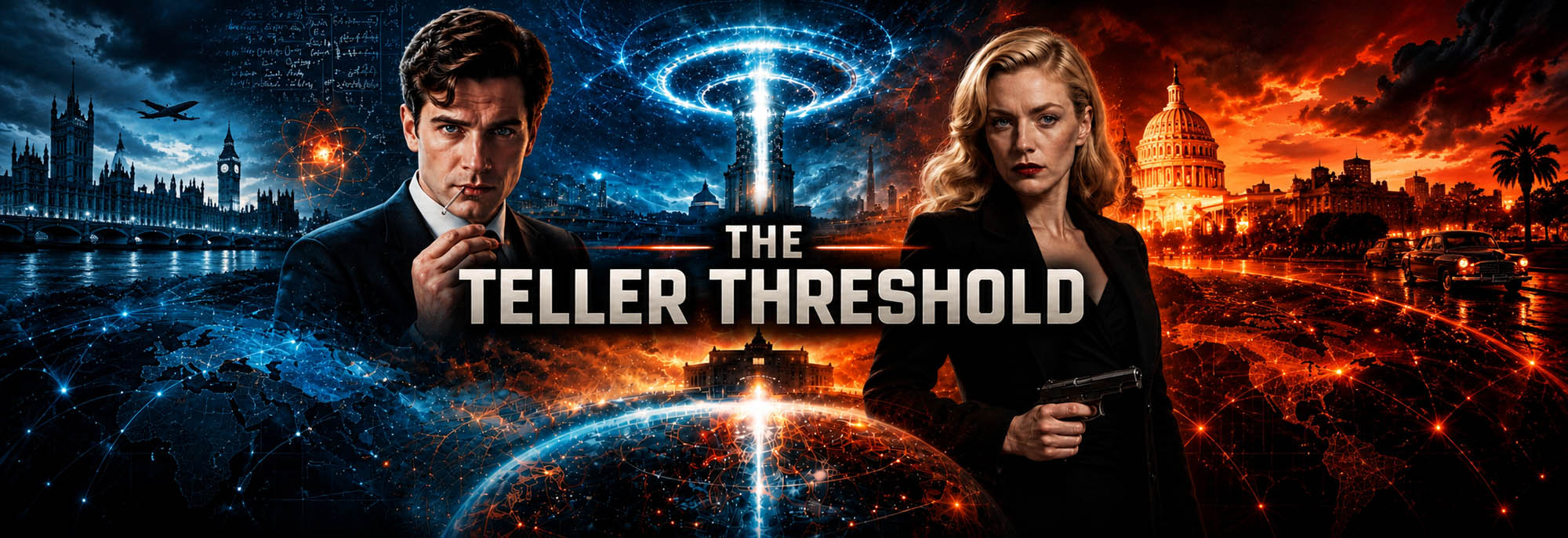
As the United States races to perfect the hydrogen bomb, another threat emerges from the shadows of Cold War scientific research. Derived from a mysterious apparatus known as the Mirror, a new technology offers something potentially more dangerous than nuclear superiority: the ability to eliminate disagreement without persuasion or force. Its name is Decision Locking.
When an experimental flight at Edwards Air Force Base produces an unexplained rectangular shimmer in the sky, British intelligence officers Giles Harrington and Lucy Howard are dispatched under Department of Commerce cover to investigate. What initially appears to be an isolated scientific anomaly soon draws them into a covert struggle involving American research laboratories, rival intelligence agencies and a technology whose consequences extend far beyond the military.
At Livermore, California, physicist Edward Teller recognizes the implications. The same scientific advances that promise unprecedented control over nuclear weapons may also open the door to manipulating human judgment. For Teller, the danger is not simply what the technology can accomplish, but who might acquire it—and what happens when those in power discover they can manufacture agreement rather than earn it.
Within the American intelligence establishment, CIA Special Projects officer Grant Baldwin sees opportunities that others regard with alarm. Ambitious, resourceful and convinced that extraordinary threats justify extraordinary measures, Baldwin challenges the cautious approach of those determined to contain the technology. His objectives are not always clear, and neither are his loyalties.
Meanwhile, Soviet KGB Major Viktor Kolyadin pursues his own strategic interests. Methodical, patient and acutely aware of the political advantages such a breakthrough might offer, Kolyadin understands that the Cold War could be decided by something more subtle than military strength. A nation able to influence the decisions of its adversaries might never need to defeat them on the battlefield.
As their investigation carries them from California's desert testing grounds to Washington's intelligence corridors and into an increasingly dangerous international operation, Giles and Lucy discover that the struggle is no longer confined to laboratories or military installations. Governments, scientists and intelligence officers are being forced to confront questions for which there are no comfortable answers. How can a technology that alters human judgment be controlled? Who can be trusted with it? And how can anyone be certain that the decisions being made are genuinely their own?
For Giles and Lucy, the investigation becomes a test of professional loyalty, personal judgment and the uneasy alliances on which Cold War intelligence depends. Every discovery raises new questions, every apparent ally has competing interests, and the distinction between protecting national security and threatening individual freedom becomes increasingly difficult to maintain.
The Teller Threshold is a Cold War espionage thriller blending historical events, intelligence tradecraft and speculative science. Against the backdrop of the nuclear arms race, Alexander Bentley explores the collision between scientific ambition and political power, and the disturbing possibility that humanity's greatest vulnerability may not be its capacity for conflict, but its willingness to surrender the freedom to disagree.
When consensus can be manufactured, who decides what humanity is allowed to choose?

Built by Alexander Bentley. Copyright © 2026 Alexander Bentley