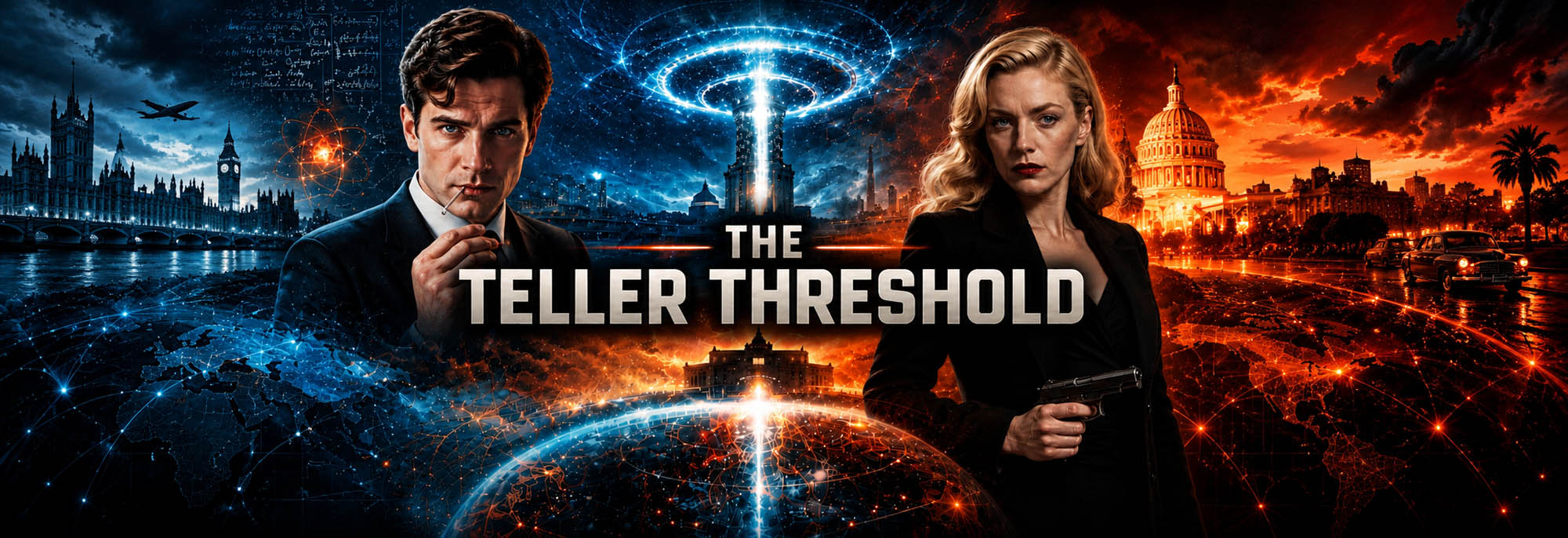
Manuscript: The Teller Threshold
Author: Alexander Bentley
Series The Consensus Files (Book One)
Genre: Cold War Espionage / Speculative Spy-Fi / Historical Thriller
The Teller Threshold is an exceptionally ambitious Cold War espionage novel that successfully blends historical intelligence fiction with speculative science while remaining firmly grounded in authentic political and military history. Rather than relying upon futuristic technology or conventional action-thriller tropes, the novel introduces a genuinely original central concept—Decision Locking—which serves simultaneously as a scientific mystery, a geopolitical weapon, and a philosophical examination of consensus, free will, and institutional behavior.
The novel succeeds because it never allows its speculative premise to overwhelm its characters. At its heart, this remains a story about intelligent, flawed people attempting to preserve independent thought within increasingly powerful systems designed to eliminate uncertainty.
By the conclusion, The Teller Threshold has established not only a satisfying standalone story, but the intellectual and narrative foundations for the wider Consensus Files series.
The novel opens as a carefully constructed Cold War investigation before gradually expanding into something much larger. Beginning with apparently isolated anomalies surrounding Livermore, Edwards Air Force Base, Camp Hero, Guatemala, and Murmansk, the investigation steadily reveals a conspiracy stretching across intelligence agencies, scientific institutions, and governments on both sides of the Iron Curtain.
One of the manuscript's greatest achievements is its pacing.
Each revelation expands rather than replaces the previous mystery. Every answer produces a larger question until the climax beneath Murmansk feels not only inevitable but completely earned.
Unlike many speculative thrillers, the ending does not depend upon a final surprise. Instead, it grows naturally from every decision made throughout the novel.
Decision Locking is one of the most original speculative concepts I have encountered within Cold War fiction.
Its brilliance lies in its restraint.
The technology does not control minds.
It removes uncertainty.
That single distinction transforms what might otherwise have been a conventional science-fiction device into something philosophically unsettling.
By the final chapters, readers understand that Decision Locking is not merely a machine.
It is a way of thinking.
That transition allows the concept to evolve naturally throughout the planned series, eventually escaping technology altogether and becoming institutional behavior—a progression already foreshadowed within The Teller Threshold.
The novel features an unusually balanced ensemble.
Each principal character occupies a distinct narrative function without unnecessary duplication.
Giles Harrington
Giles emerges as one of the novel's greatest strengths.
His progression from analytical intelligence officer to strategic thinker is gradual, believable, and psychologically convincing.
Rather than becoming increasingly confident, he becomes increasingly aware of the dangers of certainty itself.
That evolution gives the novel considerable emotional depth.
Lucy Howard
Lucy is arguably the manuscript's breakout character.
Competent, restrained, quietly humorous, and emotionally disciplined, she consistently avoids the clichés often associated with female intelligence officers in historical thrillers.
Her relationship with Giles develops through mutual trust and professional respect rather than conventional romance, making it one of the strongest partnerships in the novel.
Supporting Cast
Alicia Rayes, James Angleton, Eleanor Whitcombe, Daniel Mercer, Max Calder, and Edward Teller, each provide distinctive voices and perspectives.
Even Baldwin and Kolyadin avoid becoming conventional villains. Both genuinely believe they are protecting civilization, making their actions understandable without diminishing their danger.
One of the manuscript's defining strengths is its historical grounding.
The intelligence organizations, military procedures, aircraft, Cold War politics, scientific debates, and geographical settings consistently feel authentic.
Historical research never overwhelms the narrative.
Instead, it quietly supports it.
Locations such as Edwards Air Force Base, Guatemala, Banak, and Murmansk become believable operational environments rather than historical exhibits.
This level of research significantly enhances the novel's credibility.
Beneath its espionage narrative, The Teller Threshold explores remarkably sophisticated themes.
The novel examines:
• institutional certainty,
• manufactured consensus,
• scientific responsibility,
• bureaucratic momentum,
• individual autonomy,
• and the preservation of dissent.
Perhaps its greatest philosophical achievement is demonstrating that disagreement is not a weakness in democratic systems but an essential safeguard.
The speculative technology merely exposes an existing human vulnerability.
That thematic depth elevates the novel well beyond a conventional thriller.
The prose is disciplined, restrained, and highly visual.
Descriptions avoid unnecessary ornamentation while maintaining a strong sense of atmosphere.
Dialogue consistently sounds authentic to each character and avoids exposition-heavy exchanges.
The narrative voice remains confident throughout.
Particularly impressive is the author's increasing willingness to trust the reader.
Major concepts are revealed through implication rather than explanation, allowing readers to participate actively in understanding the larger conspiracy.
The novel occupies an increasingly attractive position within the modern thriller market.
Readers of:
• John le Carré,
• Mick Herron,
• Robert Harris,
• Daniel Silva,
• and speculative Cold War fiction
are likely to appreciate its combination of espionage realism and intellectual ambition.
Its greatest commercial strength lies in its originality.
Decision Locking provides a memorable high-concept premise that can be communicated quickly while supporting multiple novels without becoming repetitive.The manuscript also possesses significant adaptation potential. Its contained locations, visually distinctive technology, ensemble cast, and escalating geopolitical stakes lend themselves naturally to television or feature-film development.
Having reviewed the manuscript chapter by chapter, I consider The Teller Threshold to be a highly accomplished espionage thriller distinguished by an original speculative premise, exceptional historical authenticity, and mature thematic depth. The novel succeeds not because of its technology, but because it remains fundamentally about people, institutions, and the fragile value of independent thought.
Most importantly, it achieves the difficult balance required of the opening volume in a series. It delivers a satisfying conclusion while naturally encouraging readers to continue into The Budapest Reversal. The larger mythology expands without diminishing the emotional completeness of the first novel.
Strongly Recommended
The Teller Threshold stands out as an intelligent, historically grounded espionage novel that combines the procedural precision of classic Cold War fiction with a genuinely original speculative idea. Its confidence, restraint, and philosophical depth distinguish it from many contemporary thrillers, while its ending lays a compelling foundation for what could become a significant Cold War spy-fi series.