Before the detonation of the first atomic bomb at the Trinity nuclear test in July 1945, the scientists of the Manhattan Project carried a set of fears unlike anything in scientific history. They were not simply worried the bomb might fail. Some feared it might destroy the world.
The most famous and terrifying concern was atmospheric ignition.
Physicists understood that the bomb would generate temperatures at the center of the explosion hotter than those of the sun’s core. The fear was that this unprecedented heat could trigger a runaway nuclear fusion reaction in the nitrogen or hydrogen present in the Earth’s atmosphere. If that happened, the atmosphere itself could ignite and continue burning uncontrollably around the planet.
This possibility was seriously discussed in the months before Trinity. Calculations by physicists, including Edward Teller and Hans Bethe, eventually concluded the risk was extraordinarily small.
But “extraordinarily small” was not zero.
The calculations depended on theoretical physics pushed beyond any experimentally verified boundary. That uncertainty haunted many of the scientists involved.
Another fear was the oceans igniting. Some worried the bomb’s heat could trigger fusion reactions in deuterium within seawater, effectively setting parts of the oceans into uncontrolled reaction. This idea was eventually dismissed on mathematical grounds, but it reflected how little certainty existed once energies reached thermonuclear levels.
There were also fears of unknown physical effects — consequences nobody had predicted because humanity had never released energy at this scale before. Many of the Manhattan Project physicists privately feared they were crossing a threshold where theory might no longer reliably predict reality.
Several scientists later described Trinity as an experiment where the outcome could not be guaranteed with complete certainty. J. Robert Oppenheimer himself reportedly joked about betting on whether the bomb would ignite the atmosphere, but beneath the dark humor was genuine unease. The atmosphere-ignition question had been formally investigated precisely because enough physicists considered it plausible enough to require proof against it.
Beyond physical fears were profound philosophical and moral fears.
Some scientists believed the bomb would permanently alter civilization by making human self-destruction technologically inevitable. A number of scientists working on the project became psychologically distressed as Trinity approached because they realized they were creating something fundamentally different from every previous weapon in human history. Dynamite, artillery, and chemical weapons still operated within recognizable scales of destruction. Atomic weapons introduced civilization-scale destruction for the first time.
There was also fear of losing control politically and militarily once the weapon existed. Those fears proved largely correct in the decades that followed during the Cold War.
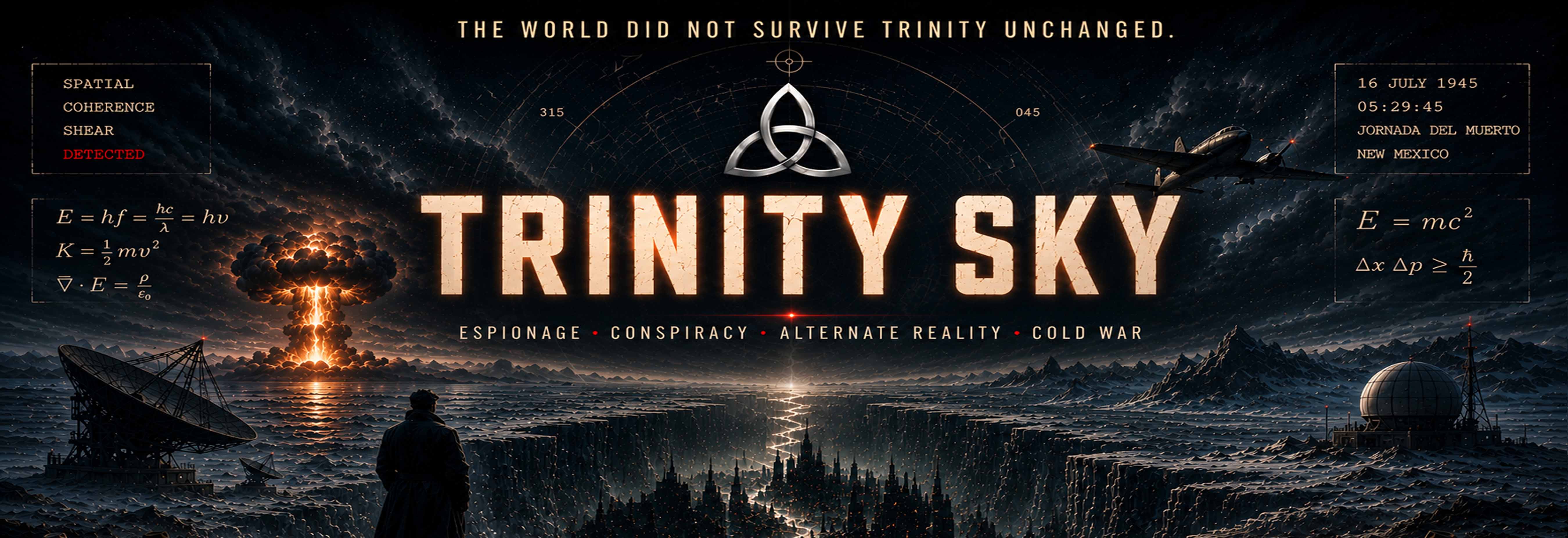
Trinity Sky takes one of the most historically real fears — atmospheric ignition — and transforms it into something even more unsettling: the idea that the scientists were wrong not about fire, but about reality itself. Instead of igniting the atmosphere chemically, the Trinity blast damages “spatial coherence,” creating fractures in time, geography, and causality.
Trinity Sky grows directly out of authentic historical anxieties rather than invented science-fiction fears. The real scientists genuinely worried they might trigger a planetary catastrophe. The story simply asks:
“What if the catastrophe happened in a form nobody knew how to measure?”
This concept is reinforced throughout the Trinity Sky, where nuclear detonations gradually undermine reality’s stability, producing “Null Sectors” where time and geography fail.
One of the lesser-known but very real fears surrounding early atomic weapons was that scientists did not fully understand how a nuclear detonation might interact with the Earth’s electromagnetic environment.
In 1945, understanding of the ionosphere, magnetosphere, radiation belts, and large-scale atmospheric electrical behavior was still incomplete. Radar itself was relatively new. Long-range radio propagation was not fully understood. The upper atmosphere remained scientifically mysterious. Many Manhattan Project scientists worried that introducing an artificial “sun” into the atmosphere could produce effects beyond blast and radiation.
At the time, long-distance radio communication depended heavily on the ionosphere — the electrically charged layer of the upper atmosphere that reflects radio waves back toward Earth. Scientists worried that a nuclear detonation might temporarily “blind” portions of the atmosphere to radio transmission or create massive reflection anomalies.
Some physicists feared radio blackouts across continents, false radar returns, navigational failures, electrical surges in military infrastructure, and disruptions to aircraft and naval communications. In 1945, these possibilities mattered enormously because World War II command-and-control systems relied increasingly on radio, radar, and electronic coordination.
Importantly, the full scale of electromagnetic pulse (EMP) effects was not yet understood. The concept existed in primitive form, but nobody fully grasped how large nuclear detonations, particularly at high altitude, could generate massive electromagnetic pulses capable of damaging electrical systems over vast areas.
Later Cold War tests proved those fears were justified. For example, the Starfish Prime detonation over the Pacific created widespread radio disruption, streetlight failures in Hawaii, electronic damage hundreds of miles away, artificial radiation belts in Earth orbit, and satellite malfunctions.
The test demonstrated that nuclear weapons interacted with the Earth’s electromagnetic environment far more dramatically than many early scientists anticipated. That retroactively validated some of the original Trinity-era anxieties - not that the atmosphere would ignite, but that nuclear detonations could produce planetary-scale technological and environmental side effects.
In Trinity Sky, electromagnetic disturbances naturally bridge hard science and eerie unreality. Trinity Sky extends that idea one terrifying step further - the detonations do not merely disrupt electronics - they disrupt the underlying coherence that allows space, time, signals, and causality to remain synchronized.
All of these effects together in Trinity Sky make the storyline feel like a natural extrapolation of authentic Cold War scientific fears rather than purely fantastical inventions.